Saturday, August 31, 2019

Henry Neville's Library of Shakespeare Sources

[Update 10/24/2019: Steadily, I am publishing the complete book list with links to the specific edition of each book. Check out the Henry Neville Research Wiki for more.]

Scholars have carefully traced the sources used in the creation of the works of Shakespeare. Dozens of books have been identified in English, Latin, Italian, and French which the author of the works of Shakespeare must have read.

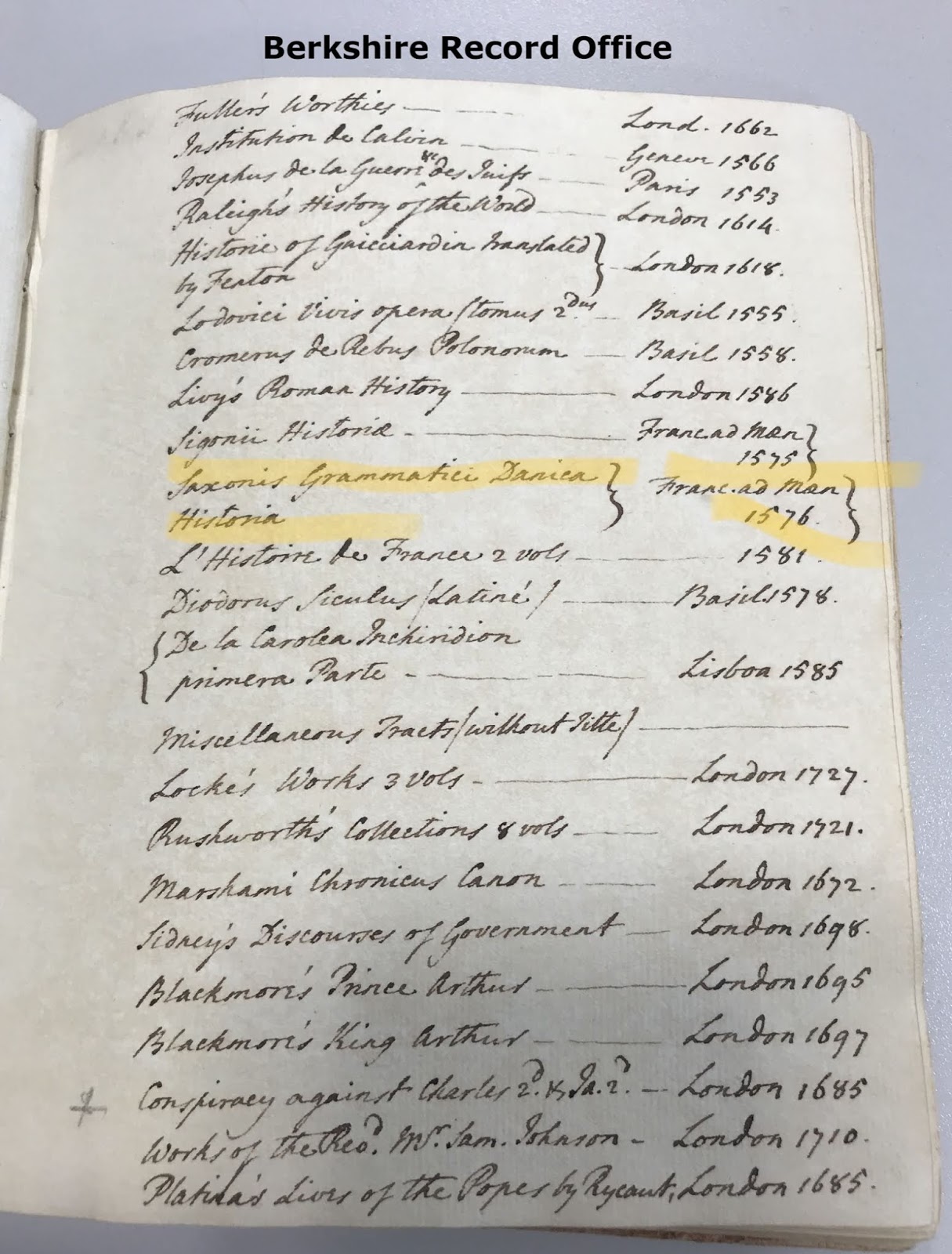
Henry Neville (1563-1615) left behind a large library. In 1780, a catalog was made of the books at his home at Billingbear. Examining that list shows an extraordinary correlation with the sources used by Shakespeare. Some of these books are currently at Audley End.

I visited the Berkshire Record Office last week and photographed this catalog. With their permission, I will highlight some of the most interesting connections between that catalog and the works of Shakespeare.


Source texts are one of the most reliable means to determine authorship. Only someone who had access to -- and could read -- the source texts could have written the works of Shakespeare. The alignment between Shakespeare's sources and Neville's library provides strong evidence supporting his authorship.


Othello and Measure for Measure - Cinthio's Gli Hecatommithi

This article from the British Library gives a good overview of how the plays Othello and Measure for Measure are based on Cinthio's Gli Hecatommithi. Henry Neville owned a 1580 edition of the book:


Here is the cover page of the edition cited in the above Billingbear catalog entry:


Unfortunately, this book doesn't appear to currently be at Audley End. This book, in Italian, was not widely read in England at the time. It is quite an extraordinary coincidence that Henry Neville owned this book which was the main source of two Shakespeare plays.

Hamlet - Saxonis Grammatici Danica Historia

This Latin book, also called the Gesta Danorum, is the ultimate source for Hamlet. The British Library has an excellent description of the book's connection with Hamlet.


This is the cover page of the edition of the book listed in the catalog, you can read it on Google Books:


Here is the Wikipedia entry for Gesta Danorum, it discusses in detail the editions of the book and its relation to Hamlet.

All's Well that Ends Well and Cymbeline - Boccaccio's Decameron

Henry Neville seems to have owned two copies of Boccaccio's Decameron, 1527 and 1555, and it is a major source for the works of Shakespeare.


Here is  Wikipedia on All's Well that Ends Well:

"The play is based on a tale (tale nine of day three) of Boccaccio's The Decameron."

Here is Wikipedia on Cymbeline:

"The subplot of Posthumus and Iachimo's wager derives from story II.9 of Giovanni Boccaccio's The Decameron and the anonymously authored Frederyke of Jennen."

Sonnet 144 also references The Decameron and The Two Gentlemen of Verona may also have used it as a source.

Much Ado About Nothing - Ludovico Ariosto's Orlando Furioso 


Here is the cover for this 1580 edition, you can read it on Google Books:


Wikipedia explains the connection with Much Ado About Nothing:

"Another version featuring lovers Ariodante and Ginevra, with the servant Dalinda impersonating Ginevra on the balcony, appears in Book V of Orlando Furioso by Ludovico Ariosto, published in an English translation in 1591. The character of Benedick too has a counterpart in a commentary upon marriage in Orlando Furioso, but the witty wooing of Beatrice and Benedick is original and very unusual in style and syncopation."

Troilus and Cressida and Two Noble Kinsmen - Chaucer's Works


Here is the cover for this 1602 edition, you can read the whole thing on Archive.org:


This edition does not appear to be at Audley End. The first edition of this book was in 1598 and Henry Neville appears to have owned the second, 1602 edition. Though Chaucer is believed to be an influence on the entire Shakespeare canon, the two major works with Chaucer as a source were written in 1602 and later:

Here is Wikipedia on the source Shakespeare's Troilus and Cressida's sources:

"The story of Troilus and Cressida is a medieval tale that is not part of Greek mythology; Shakespeare drew on a number of sources for this plotline, in particular Chaucer's version of the tale, Troilus and Criseyde, but also John Lydgate's Troy Book and Caxton's translation of the Recuyell of the Historyes of Troye."

Here is Wikipedia on the source for Shakespeare/Fletcher's Two Noble Kinsmen:

"Its plot derives from "The Knight's Tale" in Geoffrey Chaucer's The Canterbury Tales"

Hamlet and other works - Sextus Empiricus 

Sextus Empiricus was a Greek skeptic philosopher. You can read about him on Wikipedia or the Stanford Encyclopedia of Philosophy. Henry Neville had a 1569 edition of his works translated into Latin:


You can download a copy of this edition on Google Books:


There is an extensive academic literature connecting the philosophy of Sextus Empiricus with the works of Shakespeare.

For instance, in "Shakespeare and the Ten Modes of Skepticism," Robert Pierce writes: "My aim is to demonstrate some striking parallels with Pyrrhonist thought in Shakespeare's plays and poems and then to... associate  Shakespeare with scepticism as many critics have done, but in a more specific way, aiming at what is distinctively Pyrrhonist." (Shakespeare Survey, Volume 46)

See also:
Skepticism and Memory in Shakespeare and Donne by Anita Gilman Sherman.
Shakespeare's "Hamlet" and Renaissance Skepticism by Steven Jay Doloff
Rethinking Shakespeare's Skepticism by Suzanne M. Tartamella

Rape of Lucrece and Coriolanus  - Dionysius of Halicarnassus and Diodorus Siculus

Neville's library included a copy of the Latin translation of the history of  Diodorus Siculus:


Here is the title page for this edition, you can see the whole thing on Google Books:


Neville also had the 1546 edition of the history of Dionysius of Halicarnassus in Greek:


Both of these books deal with the story of the Rape of Lucrece, and are possible source material for the Shakespeare poem published in 1594.

For more information see:
Redeeming Lost Honor: Shakespeare's Rape of Lucrece

They also may have provided source material for Shakespeare's Roman plays. This may be a fruitful area for further research.

Othello - Historia della guerra fra Turchi, et Persiani

Giovanni Tommaso Minadoi's 1594 Historia della guerra fra Turchi, et Persiani is a possible source for Othello:


You can read the entire thing on Archive.org, here is the title page:


Titus Andronicus - Herodian's Roman History


Here is the title page of the 1581 Greek/Latin edition that was in Neville's library, you can read the whole thing on Google Books:


See the Wikipedia entry:

G. K. Hunter has suggested Shakespeare may have taken Saturninus' name from Herodian's History of the Empire from the Death of Marcus, which features a jealous and violent tribune named Saturninus


Summary

This is only the beginning of the connections between Neville's library and the works of Shakespeare. I will post more soon.

What is important to realize is that this book list is going to greatly expand our understanding of what constituted "Shakespeare's sources." There are many books on Italian history and politics. As scholars go through these books, they will almost certainly find echoes in Shakespeare's Italian plays. The Roman history plays also need to be re-evaluated with this book list as background.

So far we have only been able to figure out the sources for the works of Shakespeare working backwards from the plays and poems. This book list lets us move forward from source texts the author may have read, in whole or in part.

Friday, August 16, 2019

Shakespeare, Southampton, Humphrey Fludd and Henry Neville

MAJOR UPDATE!!!

Dr. Andrew Zurcher has identified the writer of this letter as Robert Drury, the husband of Anne Bacon Drury. Anne Bacon Drury was the niece of Henry Neville's stepmother, Elizabeth Bacon. The Drurys were major patrons of John Donne, you can read it about it in the book Donne & the Drurys.


I have discovered an extremely interesting letter in the National Archives.

The letter was written to Henry Neville while he was ambassador to France. It mentions both the Earl of Southampton and Humphrey Fludd. Here is the letter, shared with permission of the National Archives. The designation of this letter is PRO 30/50/2/97. Here is the link to the Archives.


Here is a modern spelling transcription, done with the help of John O'Donnell:
Sir, I did not a whit mistake what I writ unto you concerning the letters, for proof whereof Humphrey Fludd, who hath been here with the Commander of Dieppe, assureth me he saw my Lord of Southampton's letter to me, upon a table in your house, laid down amongst many other letters. And for Mr. Secretary's letter, he told me himself, at my coming over hither, he had sent it by post in your packet. But for this I do think it might very well be a compliment, that it pleased Mr. Secretary [Robert Cecil] to use me, and for the other, it might very well be lost not being cared for by anybody. But Sir, those things, are not worth any more speaking of. I will not be jealous it you would willingly do me any wrong, and so will rest. 
Your very loving friend to do you service. 
London. 6. May. 1600. 
(R. Drury)
Here is more information on Humphrey Fludd. He was deposed in the Bellot v. Mountjoy case along with William Shakespeare. 

We know that Humphrey Fludd was a professional courier. It is mentioned in Winwood's Memorials, here Ralph Winwood specifically mentions a letter sent via Fludd to Henry Neville.


The Shakespeare Circle: An Alternative Biography by Paul Edmonson and Stanley Wells, cites a secondary source, A Biographical Dictionary of English Court Musicians:
"Between 1608 and 1618 he was paid numerous times for carrying official letters to and from France."
Update: Here is a reference to Robert Drury:


Sunday, July 28, 2019

New Henry Neville Letter to an Unknown Woman ca. 1605

Henry Neville often kept drafts of his letters to serve as copies for his own use. I discovered an example of this in The National Archives and Neville researcher John O'Donnell has transcribed it.

It was likely written around 1605. We don't know yet to whom it was written, but this is the first example we have so far of a letter written by Henry Neville to a woman.


I will put in bold some parts that relate directly to the works of Shakespeare. I have modernized spelling for ease of reading:

Honorable Lady,

The honour I bear unto your self and to the house whereinto you have matched, makes me careful to give you the best satisfaction I can in all things. Therefore taking notice that you have conceived some offense that I gave not such entertainment as you expected unto a youth you sent unto me by the name of my nephew, I thought good before I went out of Town by these few lines to give you a true account of that matter, both what I did & why, and so leave it to your Judgement well informed to censure, with that favor that I presume of from you.

True it is that a servant of your ladyship's came unto me and told me that you had sent a nephew of mine which worked upon you to see me. I asked him what nephew he answered a Nevill, a brother's son of mine. I told him surely it was mistaken. for I had but one brother that had sons, the oldest whereof was brought up in my house, and the rest so young as I knew they were not fit to come out of his own. He replied that it was Francis Nevill's son. I answered that indeed such a brother I
had, though I had little Joy of him [Love's Labour's Lost], but that I was sure he had no children born in marriage; and for any other I would acknowledge no kindred to them.

I prayed him to commend my service unto your ladyship. and to let you know so much for I perceive you were abused in this information, and there was a mystery in it. Now Madame if by this occasion I have been driven to open that which might otherwise have been concealed, let not me be blamed, but the mother, who knowing all this to be true, would needs obtrude this matter upon me. For my part, I have reasons, & such as may concern my posterity in their inheritance to disclaim him as my brothers lawful son. Therefore your lap. I am sure will in your Judgement excuse me, if being sent to me in that quality of my nephew (which I know you did believing it to be so) I refused to acknowledge him for such.

In any other quality, not only he, but the meanest in your house coming from your ladyship, should have been, & ever shall be received, with that respect that I confess to be due unto you and which I will be ever ready to yield you. But this in very truth I did conceive to be a devise of the mothers, to insinuate by means, that which I may in no wise give way unto. And I must confess, that I was not willing to be so wrought upon by her. And that I assure your ladyship was my reason, and no want of affection or respect to your self, as I shall ever appear by my readiness to do you any service that shall lie in my power, when it shall please you to command me. And so appealing to your Judgement and favor for a good construction [Coriolanus] of my proceeding in this matter, and desiring to retain a place in your good conceit I humbly take my leave and remain

your ladyships very respective
kinsman to be commanded.

Shakespeare's Sonnet 121, John Vicars, and Vile Things

I believe I am the first person to notice this.

In 1619 John Vicars published an English translation of John Owen's book of epigrams: Epigrams of that most wittie and worthie epigrammatist Mr. Iohn Owen, Gentleman. Translated by Iohn Vicars. Here is the ESTC entry and the EEBO full text.

The Epigram to Henry Neville is of particular interest. The original epigram was written to Henry Neville of Abergavenny, the husband of Mary Sackville Neville and the son-in-law of Thomas Sackville, the 1st Earl of Dorset. It was not about the Henry Neville of Billingbear who may have written the works of Shakespeare.

However, both Henry Nevilles shared the same family motto: "ne vile velis". John Davies of Hereford wrote a Sonnet to Henry Neville of Billingbear in his 1603 Microcosmos, and in that book he makes a pun on this family motto (see the full Sonnet here): "All which presume thou art not gilt by guile / Because they noble name* denies the vile." *Ne-vile  [Note the asterisk and the gloss are included in the original book.]

Here is the John Vicars' translation of the Epigram:
EPIG. 66. Sir Henry Nevill his Adagie. Wish no vaine thing.
NO vaine, nor vile thing wish to have,
This Counsell is both wise and grave:
For, base things are of base esteeme,
And wisemen, vaine things, nought worth deeme.
Shakespeare's Sonnet 121

There is a very interesting parallel here with Shakespeare's Sonnet 121 which also has "vile" repeated twice and rhymes "esteemed" with "deemed":
’Tis better to be vile than vile esteemed,
When not to be receives reproach of being,
And the just pleasure lost, which is so deemed
Thomas Vicars Reference to Shakespeare and John Vicars

In 1628, Thomas Vicars, whose mother-in-law was Henry Neville's widow, published a curious note about William Shakespeare in his book. The note includes a reference to John Vicars, who wrote the above epigram (translation from the Philological Museum):
To these, I think, should be added that well-known poet who takes his name from the shaking of a spear, John Davies,  and a pious and learned poet who shares my surname, John Vicars.
[Thanks to James Leyland for his helpful discussion of this issue.]

"un-" words in Grenewey's Tacitus and Shakespeare: Part 4

The author of the works of Shakespeare tended to be creative/productive with the "un-" prefix. I can actually quantify this, but I will leave that for later. Trust me; it's really characteristic of the author and has been noted by others. It's one "tell" we can use to help identify works by Shakespeare.

So it might be instructive to go through the "un-" words in Grenewey's Tacitus and see if it shows us any clues. There are about 145 unique "un-" words in the text. For comparison, in the entire Shakespeare canon, there are approximately 700 unique "un-" words.

I've left the original spelling and compared each un- word with the database at Open Source Shakespeare and Phase 1 EEBO. (Those with the interest can easily supplement this with a Phase 2 EEBO search.) This will give us a general idea of how common a word was at the time and how often it appears in Shakespeare's works.

What Can We Conclude from This Analysis?

This analysis clearly shows a baseline
of common authorship between the works of Shakespeare and Grenewey's translation of Tacitus. Both authors very freely use 'un-' words in creative ways. There are unusual 'un-' words in common as well as many many overlapping uses of more common words.

This is certainly far from proof of common authorship! A few unusual words in common may be just coincidence or a common influence. The number and variety of un- words may just be due to both authors coincidentally having a tendency in that direction.

A more systematic analysis of words in EEBO for their use of un- words would offer us even more insight into this. Do some texts use rare un- words much more than others? Use un- words much more often? This is an exciting area of possible future research into authorship attribution.

Unusual Un- Words in Shared by Shakespeare and Grenewey's Tacitus

These are the words that appear in Grenewey's translation which, if you do a Phase 1 EEBO search, appear to be relatively uncommon words. So, for instance, the word "untuned" has about 30 hits before 1623. "unguarded" has about 50. These are not by any means rare words, but they contrast with many words listed below as "common" which have many hundreds or even thousands of uses in that time frame.

There are a few words, though, which really do seem to be uncommon. "unsquared," in particular, appears to have been very rare. Only a handful of uses are in the database, so the common use between Shakespeare and Grenewey is notable. "unbacked" and "uncoined" are also notably uncommon.

vnsquared - extremely uncommon (1 Shax, Troilus and Cressida)
vnbacked - uncommon (2 Shax)
vncoyned - uncommon (1 Shax, Henry V)
vnhandsome - somewhat common (4 Shax)
vnpolished - somewhat uncommon (4 Shax)*
vnstained - somewhat uncommon (4 Shax)
vntrained - somewhat uncommon (1 Shax, Love's Labour's Lost)
vntried - somewhat uncommon (1 Shax)
vntrimmed - somewhat uncommon (1 Shax, King John)
vntuned - somewhat uncommon (3 Shax)
vnuiolated - somewhat uncommon (1 Shax, Comedy of Errors)
vngarded - somewhat uncommon (3 Shax)
vnpractised - somewhat common (3 Shax)

Very Unusual Un-Words in Grenewey's Tacitus

Here are examples of un- words that appear in Grenewey's Tacitus but seem to be very rare overall. it shows that the translator did freely use the un- prefix even in cases where he likely never saw a similar example.

vncircumpection - extremely uncommon (0 Shax)
vnc(o/u)mbred - very uncommon (0 Shax)
vnwontednes - very uncommon (0 Shax, several "unwonted")
vnnestle - extremely uncommon (0 Shax)
vndedicated - very uncommon (0 Shax)


All the Rest

Here are the rest of the examples.

vnaccustomed - common (5 Shax)
vnacquainted - common (3 Shax)
vnaduertised - uncommon (0 Shax, but occurs in Hall's Chronicles, a known Shakespeare source)
vnaduised - common (8 Shax)
vnaduisedly - common (1 Shax, Richard III)
vnapt - common (6 Shax)
vnarmed - common (8 Shax)
vnasked - somewhat common (1 Shax, Venus and Adonis)
vnattempted - somewhat common (1 Shax)
vnawares - common (5 Shax)
vnbeaten - uncommon (0 Shax)
vnbound - common (3 Shax)
vnbrideled - common (2 Shax)
vnburdened - somewhat common (0 Shax, "unburden" in Merchant of Venice)
vnburied - common (2 Shax)
vncertain(e) - common (11 Shax)
vncertaintie(s) - common (3 Shax)
vnchanged - somewhat common (0 Shax) [further study]
vnchast(e) - common (4 Shax)
vnchastnes - uncommon [further study]
vncircumspect - uncommon (0 Shax) ["circumspect" appears twice]
vncircumspectly -  uncommon (0 Shax)
vnciuill - common (8 shax)
vncleane(s) - common (5 Shax)
vncleannes - common (2 Shax)
vncloath(ed) - common (0 Shax)
vnconsiderate - uncommon (0 Shax)
vnconsideratly - uncommon (0 Shax)
vnconstancie - somewhat common (0 Shax)
vnconstant - common (4 Shax)
vncorrupt - common (0 Shax)
vncorrupted - common (0 Shax)
vncorruptly - somewhat uncommon (0 Shax)
vncouer - common (1 Shax)
vncouered - common (5 Shax)
vncredible - common (0 Shax)
vndecently - uncommon (0 Shax)
vndefended - uncommon (0 Shax)
vndefensed - uncommon (0 Shax)
vndefiled - common (0 Shax)
vndeserued - common (5 Shax)
vndiscretion - uncommon (0 Shax)
vndone - common (10+ Shax)
vndoubted - common (4 Shax)
vneasie - common (4 Shax)
vnequall - common (5 Shax)
vnequally - common (0 Shax)
vneuen - common (7 Shax)
vnexperienced - common (2 Shax)
vnexpert - somewhat common (0 Shax)
vnexpertest - extremely unusual (0 Shax)
vnfainedly - common (3 Shax)
vnfit - common (10 Shax)
vnfortified - somewhat common (1 Shax, Hamlet)
vnfortunat(e) - common (10 Shax)
vnfurnished - common (1 Shax, Romeo and Juliet)
vngracious - common (8 Shax)
vngratefull - common (7 Shax)
vnhabited - somewhat common (0 Shax)*
vnhappie - common (10+ Shax)
vnh(e)ard - common (4 Shax)
vnhonest - common (0 Shax)
vnhurt - somewhat common (0 Shax, "unhurtful" in Measure for Measure)
vninuited - uncommon (0 Shax)
vniust - common (10+ Shax)
vniustly - common (8 Shax)
vnknown - common (10+ Shax)
vnlaboured - uncommon (0 Shax)
vnlaced - somewhat common (0-1 Shax, "Passionate Pilgrim")
vnlawfull - common (10+ Shax)
vnlearned - very common (3 Shax)
vnlike - common (10+ Shax)
vnlikely - common (4 Shax)
vnlooked - common (10+ Shax)
vnluckely - common (6 Shax)
vnlucky - common (6 Shax)
vnlustie - common (0 Shax)
vnmeete - common (6 Shax)
vnmeetest - uncommon (0 Shax) in Golding's Plutarch
vnmindfull - common (1 Shax, Richard III)
vnnatural(l) - common (10+ Shax)
vnnaturally - common (1 Shax)
vnoccupied - common (0 Shax) EC
vnorderly - somewhat common (0 Shax)
vnpleasant - common (1 Shax)
vnpleasing - somewhat common (5 Shax)
vnprofitable - very common (6 Shax)
vnprosperous - somewhat common (0 Shax)
vnprouided - common (7 Shax)
vnpunished - common (0 Shax)
vnquiet - common (8 Shax)
vnreadie - somewhat common (3 Shax, Henry VI, Part 1)
vnreasonable - common (4 Shax)
vnreasonably - somewhat common (1 Shax, Coriolanus)
vnrecompensed - uncommon (0 Shax)
vnrestrained - somewhat uncommon (1 Shax, Richard II) CG
vnreuenged - common (2 Shax)
vnreuerent - common (3 Shax)
vnrulines - somewhat common (0 Shax)
vnruly - common (10+ Shax)
vnsaide - somewhat uncommon (0 Shax)
vnseasonable - common (4 Shax)
vnseasonably - common (1 Shax, As You Like It)
vnseem(e)ly - common (1 Shax, Romeo and Juliet)
vnshaken - somewhat common (2 Shax)
vnskilful(l) - common (5 Shax)
vnskilfully - common (1 Shax, Measure for Measure)
vnskilfulnes - common (0 Shax)
vnsought - common (3 Shax)
vnstayedly - uncommon (0 Shax)
vntackled - very uncommon (0 Shax)
vntemperate - common (0 Shax)
vntied - common (2 Shax)
vntimely - common (10+ Shax)
vntol(l)erable - common (0 Shax)
vntouched - common (2 Shax)
vntowardly - common (1 Shax, Much Ado About Nothing)
vntrue - common (7 Shax)
vntruly - common (0 Shax)
vnusuall - common (6 Shax)
vnwarlike - somewhat uncommon (0 Shax)
vnwasted - uncommon (0 Shax)
vnwholesomnes - uncommon (0 Shax)
vnwilling - very common (10+ Shax)
vnwillingly - common (6 Shax)
vnworthy/ie - very common (10+ Shax)
vnwrought - somewhat uncommon (0 Shax)

Thursday, July 25, 2019

Part 4: Vocabulary in Grenewey's Tacitus and Shakespeare:

This is not a systematic comparison of the vocabulary of Grenewey's Tacitus and the works of Shakespeare. But there are definitely some interesting words in common, and I'd like to share some with you.

It would also make sense to systematically investigate the vocabulary used in the Tacitus translation and compare it with the works of Shakespeare. I look forward to doing that in the future, but to do well, such a study would require the "lemmatization" of the text. First, the spelling would need to be modernized, then each word transformed into its dictionary headword form. Let me know if you'd be interested in such a project!

Until then, please enjoy this very limited qualitative comparison. Note that the correlations involve Shakespeare works that are earlier, written at the same time, and written later. The author of the works of Shakespeare has some affinity in vocabulary and interests with Richard Grenewey. It could be, of course, that Grenewey read Shakespeare and then Shakespeare read Grenewey. Or it could be coincidence.

Lots of possibilities!

Wind-pipe 

It was conjectured by sickness because that his wind-pipe within swelling by little and little and in the end stopped he yielded up the ghost. (216)

Let gallows gape for dog; let man go free
And let not hemp his wind-pipe suffocate:
But Exeter hath given the doom of death
For pax of little price. - Henry V, 3.6

There's much example for't; the fellow that sits
next him now, parts bread with him, pledges the
breath of him in a divided draught, is the readiest
man to kill him: 't has been proved. If I were a
huge man, I should fear to drink at meals;
Lest they should spy my windpipe's dangerous notes:
Great men should drink with harness on their throats. - Timon of Athens, 1.2

Aedile

Roman History. Any of several magistrates who superintended public buildings, policing, and other municipal matters. Hence in extended use: a person in charge of urban housing and building; a municipal officer.

The authority of the Aediles is also restrained, and order set down how much the Curules, and the people might take to pawn, and how far they might punish. (187, occurs many times in book)

What do ye talk?
Have we not had a taste of his obedience?
Our aediles smote? ourselves resisted? Come. - Coriolanus, 3.1 (occurs many times in play)

Garboil

Confusion, disturbance, tumult; an instance of this, a brawl, hubbub, hurlyburly.

I prefer old quietness before new garboils; not ho∣ping for any reward thereby; but only to excuse my self from disloyalty, and to serve for a convenient means of reconciliation for the German nation. (23)

That the name of liberty was falsely pretended by them, who being base and degenerate of themselves, and dangerous to the whole state; have no hope but in time of trouble and garboil. (146)

As in times past (said he) the city desirous of garboil, spake of C. Caesar, and M. Cato; so now of thee ô Nero and Thrasea, and hath his adherents or rather followers. (253)

She's dead, my queen:
Look here, and at thy sovereign leisure read
The garboils she awaked; at the last, best:
See when and where she died. - Antony and Cleopatra, 1.3

So much uncurbable, her garboils, Caesar
Made out of her impatience, which not wanted
Shrewdness of policy too, I grieving grant
Did you too much disquiet: for that you must
But say, I could not help it. - Antony and Cleopatra, 2.2

Hurly burly

The change of the Prince gave licence of hurlyburly, and hope of gain by civil wars. (8)

Then understanding of the hurly burly of the legions, departing in all speed, met the soldiers out of their camp, hanging down the head; repenting them of that they had done.  (15)

Tiberius that in so great a hurlyburly, he would still spend his labor in hearing accusers libels. (77)

the Parthian affairs were in a hurly burly; whilest they wavered, whom they should receive for their King. (144)

Of fickle changelings and poor discontents,
Which gape and rub the elbow at the news
Of hurlyburly innovation: - Henry IV, Part I, 5.1

When the hurlyburly's done,
When the battle's lost and won. - Macbeth, 1.1

Trouble brains

He understanding of so sudden a countermand, although many things at once troubled his brains. (147)

Understanding the treachery, should turn his mind, and shew love and affection to his own son: in the end she resolved to think on some singular thing which should trouble his brains, and not work his death over-hastely, (176)

Where they resign their office and their light
To the disposing of her troubled brain; - Venus and Adonis

Sir, I am vex'd;
Bear with my weakness; my, brain is troubled: - Tempest, 4.1

Featly

His son pleading against him: who finely and featly attired with a cheerful countenance; affirmed that secret practices had been wrought against the Prince.

She dances featly. - Winter's Tale, 4.4

Foot it featly here and there;
And, sweet sprites, the burthen bear. - Tempest, 1.2

Incestuous

he was constrained to know, and punish the dissolute and licentious life of his wife, immediately after to burn in an unlawful desire of incestuous matrimony.

She married. O, most wicked speed, to post
With such dexterity to incestuous sheets! Hamlet, 1.2 (several examples in this play)

Opprobriously

But Agrippina fretted and fumed that a freed woman should beard her, & a bond woman become her daughter in law; with other such like womanish complaints; not having patience to see whether her son would either repent or be filled: and the more opprobriously she upbraided him.

Think you, my lord, this little prating York
Was not incensed by his subtle mother
To taunt and scorn you thus opprobriously? - Richard III, 3.1

Abashed

Do you with cheeks abash'd behold our works,
And call them shames? which are indeed nought else. - Troilus and Cressida, 1.3

Abashed with this, the hotter unadvisedly he had grown, the more repenting; he suffered the arraigned of treason to be quit.  (30)

Adulteress

Not for the love of her husband; but least Silius having gotten the sovereignty, would reject her as an adulteress, and fall to a just consideration of her lewd life, which with his danger he had tried.
(151)

And then they call'd me foul adulteress,
Lascivious Goth, and all the bitterest terms Titus Andronicus, 2.3

Ere you can say 'she's honest:' but be 't known,
From him that has most cause to grieve it should be,
She's an adulteress. Winter's Tale, 2.1

Borderer (single use in Shakespeare)

They of those marches, gracious sovereign,
Shall be a wall sufficient to defend
Our inland from the pilfering borderers. - Henry V, 1.2

but after Germanicus death became proud towards vs, and cruel towards his subjects; confident by reason of prosperous success in wars had against his borderers (132)

Caparison

The Emperors guard was all in arms, and good order, in the field before their camp: then Caractacus vassals and retinue going before, the caparisons, his chains and all other things gotten in war against strangers, were brought after; then his brothers; his wife and daughter. (165)

What cares he now for curb or pricking spur? 
For rich caparisons or trapping gay? 
He sees his love, and nothing else he sees, 
For nothing else with his proud sight agrees. - Venus and Adonis (many other examples in Shakespeare)

Churlishly

He then ignorant of the treachery, or misdoubting violence if he seemed to perceive it, maketh haste to the city: where being churlishly received, and anon after accused in Senate, (47)

How churlishly I chid Lucetta hence, 
When willingly I would have had her here! -  Two Gentlemen of Verona, 1.2

Penknife

Under color of using it in his study, asking for a penknife, lightly prickt a vein; and ended his life, with grief and anguish of mind. 

He presents no mark to the enemy; the foeman may with as great 
level at the edge of a penknife. - Henry IV, Part II, 3.2

Public Benefit

Which did not so much turne to à publick benefit, as the destruction of many: whose wealth and fame he tyrannised by condemning them, and setting their goods to sale.

it had bene conuenient for a publick benefit to haue layd aside priuate grudges

Touching the weal o' the common, you shall find No public benefit which you receive But it proceeds or comes from them to you - Coriolanus, 1.1

Tuesday, July 23, 2019

Part 2: Grenewey's Tacitus, Shakespeare, and the OED

The hypothesis is that the translation of Tacitus done in 1598, and attributed to Richard Grenewey, was done by Henry Neville.  (See the first blog post on this issue) The other hypothesis is that Henry Neville wrote the works of Shakespeare. Combine these and we have the big question:

Did Shakespeare translate Tactitus' Annals in 1598?

As is well known, the Oxford English Dictionary over-represents the works of Shakespeare in its illustrative quotations. There are two good reasons for this. First of all, people want to see quotations from Shakespeare. Secondly, when the OED was originally written, Shakespeare concordances were available which made it very easy to find relevant quotations. Therefore, no matter what you look up in the OED, it's pretty likely there will be one, if not several, quotations from Shakespeare.

The OED also has 310 illustrative quotations taken from Grenewey's translation of Tacitus; a pretty large number. However, for comparison, just the play Henry IV, Part II, has 1,031 citations. So you can see just how uneven these numbers are, and how over-represented Shakespeare is.

With numbers like this, we should expect citations from Grenewey to be paired with Shakespeare, just by chance. Such pairings certainly do not, in and of themselves, imply common authorship.

Using the OED to Compare Word Usage

The OED makes very fine distinctions in many entries. So a single word can be broken up into dozens of senses. Most authorship attribution techniques look at a whole word and make no distinction between how that word is used. So "double down" in blackjack and "body double" would count as the same word "double".

By looking at OED entries, we can see connections between the works of Shakespeare and Grenewey's translation. We can see examples where the same words are used in similar ways. This is qualitative information rather than quantitative information. Counting up the number of "hits" doesn't really tell us much.

However, the OED editors had a motivation to not pair the quotations. The works of Shakespeare and the translation of Grenewey are from exactly the same time period. Usually, the OED tries to spread out its illustrative quotations in terms of date. So in some cases, when citations are grouped together, it's an indication of a relatively unusual use of a word.

Take the Example of Clamber

The OED lists Shakespeare and Grenewey as examples of "clamber" in a transitive use. What does this mean? If you do a search on EEBO, "clamber" wasn't a very common word. But even within those uses, almost all of them are intransitive uses. So we have "clamber up" or "clamber through" or "clamber on." But Grenewey says "clamber the tops of trees" and Shakespeare in Coriolanus has "clambering the walls." These transitive uses (use of a direct object) were actually quite rare at that time. The fact that both Shakespeare and Grenewey use the word in that way is of interest!

Third Edition vs Second Edition

The best examples are "Third Edition" entries. Those are often ones where the OED editor had full access to digital databases, so any "hit" is more likely to be due to a real similarity rather than the bias towards Shakespeare -- or the coincidence of which words from Grenewey happened to be jotted down on a slip of paper by an OED contributor. But Second Edition entries are also very valuable. I have noted which are which.

Once again, I am not suggesting that this implies common authorship. But it is very interesting to compare the style of Grenewey with Shakespeare. Since it is a qualitative comparison, you would need to read each example carefully to judge possible commonalities. I have left out some examples, these are the better ones.

[I've modernized spelling a bit for ease of reading.]

abode, v. 
transitive. To presage, foretell (usually something bad).  Now rare.
1595   Shakespeare Henry VI, Pt. 3 v. vi. 45   The owl shrikt at thy birth, an evil sign, The night Crow cride, aboding luckless tune.
1598   R. Grenewey tr. Tacitus Annales iii. ii. 67   The which when Piso perceived, to aboade his utter destruction.
[Third Edition entry; original entry just had the Shakespeare citation. Grenewey citation added in 2009.]


afeared, adj.
a1616   Shakespeare Macbeth (1623) v. i. 35   Fye, my Lord, fie, a Souldier, and affear'd ?
a1616   Shakespeare Taming of Shrew (1623) v. ii. 18   You miss my sense: I mean Hortentio is afeard of you.
1598   R. Grenewey tr. Tacitus Annales iv. xv. 114   Some came back & shewed themselves again, afeard for that they were seen to be afeard.
[Third edition entry; Grenewey citation added in 2012]

agree, v.
With on (also as to, †of, upon). To come to agreement on a matter or point; to settle something by agreement.
1598   R. Grenewey tr. Tacitus Annales vi. vii. 131   To lay down such things as they agree of.
a1616   Shakespeare Timon of Athens (1623) iii. vii. 68   To let the meat cool, ere we can agree vpon the first place.
[Third edition entry.]

bear, v.
fig. To entertain, harbour, cherish (a feeling).
1598   R. Grenewey tr. Tacitus Annales iv. ix. 103   She beareth the mind to pass the rest of her life with a Gentleman of Rome.
1602   Shakespeare Merry Wives of Windsor iv. vi. 9   The fervent love I bear to young Anne Page.
[Second edition entry]

bearing, n.
1598   R. Grenewey tr. Tacitus Annales xiv. ii. 200   Agrippina..caused herself to be carried to Baias in a bearing-chair.
a1616   Shakespeare Winter's Tale (1623) iii. iii. 112   Look thee, a bearing-cloth for a Squires childe.
[Second edition entry]

in behalf of
a1616   Shakespeare Troilus & Cressida (1623) v. iii. 22   And rob in the behalfe of charitie.
1598   R. Grenewey tr. Tacitus Annales iii. iii. 65   Not hoping to finde him cruell in his behalfe..but rather fauorable.
a1616   Shakespeare Merry Wives of Windsor (1623) i. iv. 151   Let mee haue thy voice in my behalfe.
[Second edition entry]

betake
reflexive. To commit oneself, have recourse or resort to any kind of action.
1598   R. Grenewey tr. Tacitus Annales xii. viii. 166   The enemy betook him to his heels with small loss.
a1616   Shakespeare Twelfth Night (1623) iii. iv. 215   That defense thou hast, betake thee too't
[Second edition entry]

break v.
†to break on the torture: to put to the torture, dislocate on the rack, etc.
1598   R. Grenewey tr. Tacitus Annales xi. vii. 148   Being broken on the torture, he confessed nothing.
a1616   Shakespeare Tempest (1623) iii. i. 26   I had rather crack my sinews, break my back, Then you should such dishonor undergo.
[Second edition entry]

button, v.
To close tightly; to fasten, to confine, to keep under restraint. Often with up.
1598   R. Grenewey tr. Tacitus Annales xi. ix. 151   The Princes ears would be buttoned and deaf [L. clausae].
a1616   Shakespeare Comedy of Errors (1623) iv. ii. 34   On[e] whose hard heart is button'd up with steel.
[Third edition entry]

carry, v.
to carry it away: to have the advantage, carry the day. Obsolete.
1598   R. Grenewey tr. Tacitus Annales xiii. vi. 187   This opinion carried it away.
a1616   Shakespeare Hamlet (1623) ii. ii. 361   Do the Boyes carry it away?
[Second edition entry]

clamber, v.
transitive; cf. climb v.
1598   R. Grenewey tr. Tacitus Annales ii. iv. 38   Some cowardly fleeing away, sought to clamber the tops of trees.
a1616   Shakespeare Coriolanus (1623) ii. i. 207   The Kitchin Malkin..Clambring the Walls to eye him
[Second edition entry]

father-in-law
(meaning stepfather)
1597   Shakespeare Richard III v. v. 34   All comfort that the dark night can afford, Be to thy person noble father in law .
1598   R. Grenewey tr. Tacitus Annales iii. vi. 72   A..band of alliance..betwixt the father in lawe, and his wives children.
[Third edition entry]

hammer, v.
 To devise plans laboriously, ‘cudgel one's brains’, debate or deliberate earnestly (upon, on, at, of); with upon, sometimes, To reiterate, persist in, insist upon. Obsolete.
1598   R. Grenewey tr. Tacitus Annales xv. viii. 232   He came again to Rome, hammering greatly with himself of going to the provinces of the East.
a1616   Shakespeare Two Gentlemen of Verona (1623) i. iii. 18   That Whereon, this month I have bin hammering 
also:
 Of an idea: To present itself persistently to one's mind as matter of debate; to be in agitation.
1594   Shakespeare Titus Andronicus ii. iii. 39   Blood and revenge are hammering in my head
[Second edition entry]

interess, v.
To affect injuriously; to injure, endamage.
1598   R. Grenewey tr. Tacitus Annales iii. ii. 66   Whereof being convicted, he could not be interessed; if he could purge himself of the later crimes.
a1616   Shakespeare King Lear (1623) i. i. 85   To whose young love, The Vines of France, and Milk of Burgundie, Striue to be interest.
[Second edition entry]

interlace, v.
To interweave one thing or set of things into another; to introduce as by interweaving; to insert, interpolate. Chiefly figurative or transferred. Obsolete.
1594   Shakespeare Lucrece sig. K2   Here and there the Painter interlaces Pale cowards marching on with trembling paces.
1598   R. Grenewey tr. Tacitus Annales i. iii. 6   Yet he interlaced some things among, touching his attire and behauiour.
[Second edition entry]

jump, n.
1598   R. Grenewey tr. Tacitus Annales ii. iii. 36   Being therefore at a jump to hazard all [L. igitur propinquo summæ rei discrimine], thinking it convenient to sound the soldiers mind.
a1616   Shakespeare Antony & Cleopatra (1623) iii. viii. 6   Our fortune lyes upon this jump.
[Second edition entry]

ken, v.
To descry, see; to catch sight of, discover by sight; to look at, scan. Now only archaic.
a1616   Shakespeare Henry VI, Pt. 2 (1623) iii. ii. 101   As far as I could ken thy Chalky Cliffs..I stood upon the Hatches in the storm.
absol. To see, look. Obsolete or archaic.
 R. Grenewey tr. Tacitus Annales iii. i. 63   Places, from whence a man might farthest kenne.
[Second edition entry]

lay, v.
To deal blows with vigour; to make vigorous attack, assail. (Formerly often with dative pronoun denoting the object of attack.)
1598   R. Grenewey tr. Tacitus Annales i. viii. 14   They..laide them on with stripes.
a1616   Shakespeare Macbeth (1623) v. x. 33   Lay on Macduffe, And damn'd be him, that first cries hold, enough
[Second edition entry]


mingle, v.
To bring together, intersperse, or associate (material or immaterial things, persons, etc., frequently with or among others, or one with another); to unite or join in company or (occasionally) in sexual union.
1598   Shakespeare Henry IV, Pt. 1 iii. ii. 63   The skipping king..Mingled his royalty with capring fools.
1598   R. Grenewey tr. Tacitus Annales i. viii. 14   Besides this, womens quarrels were mingled among.
[Third edition entry]

Nervii, n.
  A Celto-Germanic tribe inhabiting an area between the rivers Rhine and Schelde in northern Gaul (now Hainault, Belgium); the members of this tribe.
1598   R. Grenewey tr. Tacitus Annales 266   The Treueri and the Neruij ambitiously seem to have their beginning from the Germans.
a1616   Shakespeare Julius Caesar (1623) iii. ii. 171   That day he [sc. Caesar] overcame the Neruij .
[Third Edition Entry]

next way
the (occasionally your, etc.) next way: the shortest, most convenient, or most direct way; (in extended use) the easiest or most obvious thing to do. Now archaic and English regional.
1598   R. Grenewey tr. Tacitus Annales xiii. ix. 191   The legions were not brought the next way,..but went ouer a farre off.
a1616   Shakespeare All's Well that ends Well (1623) i. iii. 59   I speake the truth the next waie
[Third Edition Entry]

oracle, n.
 A response, decision, or message delivered by an oracle, especially one which is obscure or ambiguous in meaning.
1598   R. Grenewey tr. Tacitus Annales iii. xiii. 84   The Smyrnæans alleged an oracle of Apollo, by which they were commanded to dedicate a temple to Venus Stratonicis.
a1616   Shakespeare Winter's Tale (1623) iii. ii. 117   Therefore bring forth (And in Apollo's Name) his Oracle 
[Third edition entry]

reason, n.
A reasonable quantity, amount, or degree. Also: spec. the measure used in taking a miller's toll from a quantity of grain or flour (see toll n.1 2a(b)). Obsolete.
1598   R. Grenewey tr. Tacitus Annales vi. vi. 130   Agrippina not contented with reason, and greedy of rule.
1600   Shakespeare Much Ado about Nothing v. iv. 74   Bene. Do not you love me? Beat. Why no, no more then reason .
[Third edition entry]

Sardian, n.
An inhabitant of Sardis.
1598   R. Grenewey tr. Tacitus Annales iii. xiii. 84   The Sardians brought in matters of later memory.
a1616   Shakespeare Julius Caesar (1623) iv. ii. 55   You have condemn'd, and noted Lucius Pella For taking Bribes here of the Sardians .
[Second edition entry]

scoff, n.
‘Contemptuous ridicule; expression of scorn; contumelious language’ (Johnson); mockery. Phrase, to make scoff. Now rare or Obsolete.
1598   Shakespeare Love's Labour's Lost v. ii. 263   By heaven, all drie beaten with pure scoffe .
1598   R. Grenewey tr. Tacitus Annales i. iii. 6   [Augustus] asked the opinion of the Pontife in a scoffe, whether there might be a lawful marriage betwixt them.
[Second edition entry]

set, v.
to set naught or nought (nothing, not anything) by: to have no esteem or regard for. Obsolete.
1598   R. Grenewey tr. Tacitus Annales i. v. 8   The souldyers..set nought by all military discipline.
a1616   Shakespeare Twelfth Night (1623) v. i. 189   I thinke you set nothing by a bloody Coxecombe.

venture, v.
To dare, or have the courage, to attempt or undertake (some action); to risk the issue or result of; to venture upon (see sense 9b).
1598   R. Grenewey tr. Tacitus Annales ii. xv. 54   Catualda..ventured a revenge.
a1616   Shakespeare King John (1623) iv. iii. 5   The Wall is high, and yet will I leap down... I am afraid, and yet Ile venture it
[Second edition entry]

verse, n.
A small number of metrical lines so connected by form or meaning as to constitute either a whole in themselves or a unit in longer composition; a stanza.
1598   R. Grenewey tr. Tacitus Annales iii. xiii. 84   The Smyrnæans alleged an oracle of Apollo,..the Tenians a verse [L. carmen] of the same Apollo, commanding them to offer an image and Temple to Neptune.
a1616   Shakespeare Twelfth Night (1623) ii. iv. 7   Now good Cesario, but that peece of song, That old and Antic song we heard last night;..Come, but one verse .
[Second edition entry]