The hypothesis is that the translation of Tacitus done in 1598, and attributed to Richard Grenewey, was done by Henry Neville. (See the first blog post on this issue) The other hypothesis is that Henry Neville wrote the works of Shakespeare. Combine these and we have the big question:
Did Shakespeare translate Tactitus' Annals in 1598?
As is well known, the Oxford English Dictionary over-represents the works of Shakespeare in its illustrative quotations. There are two good reasons for this. First of all, people want to see quotations from Shakespeare. Secondly, when the OED was originally written, Shakespeare concordances were available which made it very easy to find relevant quotations. Therefore, no matter what you look up in the OED, it's pretty likely there will be one, if not several, quotations from Shakespeare.
The OED also has 310 illustrative quotations taken from Grenewey's translation of Tacitus; a pretty large number. However, for comparison, just the play Henry IV, Part II, has 1,031 citations. So you can see just how uneven these numbers are, and how over-represented Shakespeare is.
With numbers like this, we should expect citations from Grenewey to be paired with Shakespeare, just by chance. Such pairings certainly do not, in and of themselves, imply common authorship.
Using the OED to Compare Word Usage
The OED makes very fine distinctions in many entries. So a single word can be broken up into dozens of senses. Most authorship attribution techniques look at a whole word and make no distinction between how that word is used. So "double down" in blackjack and "body double" would count as the same word "double".
By looking at OED entries, we can see connections between the works of Shakespeare and Grenewey's translation. We can see examples where the same words are used in similar ways. This is qualitative information rather than quantitative information. Counting up the number of "hits" doesn't really tell us much.
However, the OED editors had a motivation to not pair the quotations. The works of Shakespeare and the translation of Grenewey are from exactly the same time period. Usually, the OED tries to spread out its illustrative quotations in terms of date. So in some cases, when citations are grouped together, it's an indication of a relatively unusual use of a word.
Take the Example of Clamber
The OED lists Shakespeare and Grenewey as examples of "clamber" in a transitive use. What does this mean? If you do a search on EEBO, "clamber" wasn't a very common word. But even within those uses, almost all of them are intransitive uses. So we have "clamber up" or "clamber through" or "clamber on." But Grenewey says "clamber the tops of trees" and Shakespeare in Coriolanus has "clambering the walls." These transitive uses (use of a direct object) were actually quite rare at that time. The fact that both Shakespeare and Grenewey use the word in that way is of interest!
Third Edition vs Second Edition
The best examples are "Third Edition" entries. Those are often ones where the OED editor had full access to digital databases, so any "hit" is more likely to be due to a real similarity rather than the bias towards Shakespeare -- or the coincidence of which words from Grenewey happened to be jotted down on a slip of paper by an OED contributor. But Second Edition entries are also very valuable. I have noted which are which.
Once again, I am not suggesting that this implies common authorship. But it is very interesting to compare the style of Grenewey with Shakespeare. Since it is a qualitative comparison, you would need to read each example carefully to judge possible commonalities. I have left out some examples, these are the better ones.
[I've modernized spelling a bit for ease of reading.]
abode, v.
transitive. To presage, foretell (usually something bad). Now rare.
1595 Shakespeare Henry VI, Pt. 3 v. vi. 45 The owl shrikt at thy birth, an evil sign, The night Crow cride, aboding luckless tune.
1598 R. Grenewey tr. Tacitus Annales iii. ii. 67 The which when Piso perceived, to aboade his utter destruction.
[Third Edition entry; original entry just had the Shakespeare citation. Grenewey citation added in 2009.]
afeared, adj.
a1616 Shakespeare Macbeth (1623) v. i. 35 Fye, my Lord, fie, a Souldier, and affear'd ?
a1616 Shakespeare Taming of Shrew (1623) v. ii. 18 You miss my sense: I mean Hortentio is afeard of you.
1598 R. Grenewey tr. Tacitus Annales iv. xv. 114 Some came back & shewed themselves again, afeard for that they were seen to be afeard.
[Third edition entry; Grenewey citation added in 2012]
agree, v.
With on (also as to, †of, upon). To come to agreement on a matter or point; to settle something by agreement.
1598 R. Grenewey tr. Tacitus Annales vi. vii. 131 To lay down such things as they agree of.
a1616 Shakespeare Timon of Athens (1623) iii. vii. 68 To let the meat cool, ere we can agree vpon the first place.
[Third edition entry.]
bear, v.
fig. To entertain, harbour, cherish (a feeling).
1598 R. Grenewey tr. Tacitus Annales iv. ix. 103 She beareth the mind to pass the rest of her life with a Gentleman of Rome.
1602 Shakespeare Merry Wives of Windsor iv. vi. 9 The fervent love I bear to young Anne Page.
[Second edition entry]
bearing, n.
1598 R. Grenewey tr. Tacitus Annales xiv. ii. 200 Agrippina..caused herself to be carried to Baias in a bearing-chair.
a1616 Shakespeare Winter's Tale (1623) iii. iii. 112 Look thee, a bearing-cloth for a Squires childe.
[Second edition entry]
in behalf of
a1616 Shakespeare Troilus & Cressida (1623) v. iii. 22 And rob in the behalfe of charitie.
1598 R. Grenewey tr. Tacitus Annales iii. iii. 65 Not hoping to finde him cruell in his behalfe..but rather fauorable.
a1616 Shakespeare Merry Wives of Windsor (1623) i. iv. 151 Let mee haue thy voice in my behalfe.
[Second edition entry]
betake
reflexive. To commit oneself, have recourse or resort to any kind of action.
1598 R. Grenewey tr. Tacitus Annales xii. viii. 166 The enemy betook him to his heels with small loss.
a1616 Shakespeare Twelfth Night (1623) iii. iv. 215 That defense thou hast, betake thee too't
[Second edition entry]
break v.
†to break on the torture: to put to the torture, dislocate on the rack, etc.
1598 R. Grenewey tr. Tacitus Annales xi. vii. 148 Being broken on the torture, he confessed nothing.
a1616 Shakespeare Tempest (1623) iii. i. 26 I had rather crack my sinews, break my back, Then you should such dishonor undergo.
[Second edition entry]
button, v.
To close tightly; to fasten, to confine, to keep under restraint. Often with up.
1598 R. Grenewey tr. Tacitus Annales xi. ix. 151 The Princes ears would be buttoned and deaf [L. clausae].
a1616 Shakespeare Comedy of Errors (1623) iv. ii. 34 On[e] whose hard heart is button'd up with steel.
[Third edition entry]
carry, v.
to carry it away: to have the advantage, carry the day. Obsolete.
1598 R. Grenewey tr. Tacitus Annales xiii. vi. 187 This opinion carried it away.
a1616 Shakespeare Hamlet (1623) ii. ii. 361 Do the Boyes carry it away?
[Second edition entry]
clamber, v.
transitive; cf. climb v.
1598 R. Grenewey tr. Tacitus Annales ii. iv. 38 Some cowardly fleeing away, sought to clamber the tops of trees.
a1616 Shakespeare Coriolanus (1623) ii. i. 207 The Kitchin Malkin..Clambring the Walls to eye him
[Second edition entry]
father-in-law
(meaning stepfather)
1597 Shakespeare Richard III v. v. 34 All comfort that the dark night can afford, Be to thy person noble father in law .
1598 R. Grenewey tr. Tacitus Annales iii. vi. 72 A..band of alliance..betwixt the father in lawe, and his wives children.
[Third edition entry]
hammer, v.
To devise plans laboriously, ‘cudgel one's brains’, debate or deliberate earnestly (upon, on, at, of); with upon, sometimes, To reiterate, persist in, insist upon. Obsolete.
1598 R. Grenewey tr. Tacitus Annales xv. viii. 232 He came again to Rome, hammering greatly with himself of going to the provinces of the East.
a1616 Shakespeare Two Gentlemen of Verona (1623) i. iii. 18 That Whereon, this month I have bin hammering
also:
Of an idea: To present itself persistently to one's mind as matter of debate; to be in agitation.
1594 Shakespeare Titus Andronicus ii. iii. 39 Blood and revenge are hammering in my head
[Second edition entry]
interess, v.
To affect injuriously; to injure, endamage.
1598 R. Grenewey tr. Tacitus Annales iii. ii. 66 Whereof being convicted, he could not be interessed; if he could purge himself of the later crimes.
a1616 Shakespeare King Lear (1623) i. i. 85 To whose young love, The Vines of France, and Milk of Burgundie, Striue to be interest.
[Second edition entry]
interlace, v.
To interweave one thing or set of things into another; to introduce as by interweaving; to insert, interpolate. Chiefly figurative or transferred. Obsolete.
1594 Shakespeare Lucrece sig. K2 Here and there the Painter interlaces Pale cowards marching on with trembling paces.
1598 R. Grenewey tr. Tacitus Annales i. iii. 6 Yet he interlaced some things among, touching his attire and behauiour.
[Second edition entry]
jump, n.
1598 R. Grenewey tr. Tacitus Annales ii. iii. 36 Being therefore at a jump to hazard all [L. igitur propinquo summæ rei discrimine], thinking it convenient to sound the soldiers mind.
a1616 Shakespeare Antony & Cleopatra (1623) iii. viii. 6 Our fortune lyes upon this jump.
[Second edition entry]
ken, v.
To descry, see; to catch sight of, discover by sight; to look at, scan. Now only archaic.
a1616 Shakespeare Henry VI, Pt. 2 (1623) iii. ii. 101 As far as I could ken thy Chalky Cliffs..I stood upon the Hatches in the storm.
absol. To see, look. Obsolete or archaic.
R. Grenewey tr. Tacitus Annales iii. i. 63 Places, from whence a man might farthest kenne.
[Second edition entry]
lay, v.
To deal blows with vigour; to make vigorous attack, assail. (Formerly often with dative pronoun denoting the object of attack.)
1598 R. Grenewey tr. Tacitus Annales i. viii. 14 They..laide them on with stripes.
a1616 Shakespeare Macbeth (1623) v. x. 33 Lay on Macduffe, And damn'd be him, that first cries hold, enough
[Second edition entry]
mingle, v.
To bring together, intersperse, or associate (material or immaterial things, persons, etc., frequently with or among others, or one with another); to unite or join in company or (occasionally) in sexual union.
1598 Shakespeare Henry IV, Pt. 1 iii. ii. 63 The skipping king..Mingled his royalty with capring fools.
1598 R. Grenewey tr. Tacitus Annales i. viii. 14 Besides this, womens quarrels were mingled among.
[Third edition entry]
Nervii, n.
A Celto-Germanic tribe inhabiting an area between the rivers Rhine and Schelde in northern Gaul (now Hainault, Belgium); the members of this tribe.
1598 R. Grenewey tr. Tacitus Annales 266 The Treueri and the Neruij ambitiously seem to have their beginning from the Germans.
a1616 Shakespeare Julius Caesar (1623) iii. ii. 171 That day he [sc. Caesar] overcame the Neruij .
[Third Edition Entry]
next way
the (occasionally your, etc.) next way: the shortest, most convenient, or most direct way; (in extended use) the easiest or most obvious thing to do. Now archaic and English regional.
1598 R. Grenewey tr. Tacitus Annales xiii. ix. 191 The legions were not brought the next way,..but went ouer a farre off.
a1616 Shakespeare All's Well that ends Well (1623) i. iii. 59 I speake the truth the next waie
[Third Edition Entry]
oracle, n.
A response, decision, or message delivered by an oracle, especially one which is obscure or ambiguous in meaning.
1598 R. Grenewey tr. Tacitus Annales iii. xiii. 84 The Smyrnæans alleged an oracle of Apollo, by which they were commanded to dedicate a temple to Venus Stratonicis.
a1616 Shakespeare Winter's Tale (1623) iii. ii. 117 Therefore bring forth (And in Apollo's Name) his Oracle
[Third edition entry]
reason, n.
A reasonable quantity, amount, or degree. Also: spec. the measure used in taking a miller's toll from a quantity of grain or flour (see toll n.1 2a(b)). Obsolete.
1598 R. Grenewey tr. Tacitus Annales vi. vi. 130 Agrippina not contented with reason, and greedy of rule.
1600 Shakespeare Much Ado about Nothing v. iv. 74 Bene. Do not you love me? Beat. Why no, no more then reason .
[Third edition entry]
Sardian, n.
An inhabitant of Sardis.
1598 R. Grenewey tr. Tacitus Annales iii. xiii. 84 The Sardians brought in matters of later memory.
a1616 Shakespeare Julius Caesar (1623) iv. ii. 55 You have condemn'd, and noted Lucius Pella For taking Bribes here of the Sardians .
[Second edition entry]
scoff, n.
‘Contemptuous ridicule; expression of scorn; contumelious language’ (Johnson); mockery. Phrase, to make scoff. Now rare or Obsolete.
1598 Shakespeare Love's Labour's Lost v. ii. 263 By heaven, all drie beaten with pure scoffe .
1598 R. Grenewey tr. Tacitus Annales i. iii. 6 [Augustus] asked the opinion of the Pontife in a scoffe, whether there might be a lawful marriage betwixt them.
[Second edition entry]
set, v.
to set naught or nought (nothing, not anything) by: to have no esteem or regard for. Obsolete.
1598 R. Grenewey tr. Tacitus Annales i. v. 8 The souldyers..set nought by all military discipline.
a1616 Shakespeare Twelfth Night (1623) v. i. 189 I thinke you set nothing by a bloody Coxecombe.
venture, v.
To dare, or have the courage, to attempt or undertake (some action); to risk the issue or result of; to venture upon (see sense 9b).
1598 R. Grenewey tr. Tacitus Annales ii. xv. 54 Catualda..ventured a revenge.
a1616 Shakespeare King John (1623) iv. iii. 5 The Wall is high, and yet will I leap down... I am afraid, and yet Ile venture it
[Second edition entry]
verse, n.
A small number of metrical lines so connected by form or meaning as to constitute either a whole in themselves or a unit in longer composition; a stanza.
1598 R. Grenewey tr. Tacitus Annales iii. xiii. 84 The Smyrnæans alleged an oracle of Apollo,..the Tenians a verse [L. carmen] of the same Apollo, commanding them to offer an image and Temple to Neptune.
a1616 Shakespeare Twelfth Night (1623) ii. iv. 7 Now good Cesario, but that peece of song, That old and Antic song we heard last night;..Come, but one verse .
[Second edition entry]
Tuesday, July 23, 2019
Monday, July 8, 2019
Richard Grenewey's Tacitus, Henry Neville, and William Shakespeare Part 1
See Also: Part 2 | Part 3 | Part 4
I'm going to try something new on this blog. I'm going to work through a hypothesis. By "hypothesis" I mean: investigating to see whether it is true. I am NOT asserting it is true. The background:
1. In 1598, "Richard Grenewey" published a translation of Tacitus' Annals. The book was printed by Arnold Hatfield, for Bonham and John Norton. Here is the ESTC entry and the full text.
2. Essentially nothing is known about Richard Grenewey. He only published one book. There are absolutely no details known about his life.
3. However, the book was dedicated to the Earl of Essex. It was also published together with Henry Savile's translation of Tacitus' Histories. That book was first published in 1591 and was dedicated to Queen Elizabeth; there was a dedication to the reader by "A.B." According to Ben Jonson, A.B. was the Earl of Essex. Here is the ESTC entry and the full text.
4. Sir Henry Neville of Billingbear was best friends his entire adult life with Henry Savile. Savile was his tutor at Oxford and they traveled together in Europe. In addition, Savile became Provost of Eton so he lived quite close to Henry Neville at Billingbear. When Neville died in 1615, Savile was executor of his will. There is extensive evidence of this close friendship; for instance, they were co-executors for the will of John Chamber and there is extant correspondence between them.
5. Henry Neville and Henry Savile were close friends with Henry Cuffe. Cuffe was a secretary and close advisor to the Earl of Essex. He tried to get Henry Neville involved with the Essex Rebellion and wrote of both Henry Neville and Henry Savile in his will at his execution.
6. In the same year, 1598, the exact same printer and publisher produced a very short anonymous book: The riddles of Heraclitus and Democritus. Here is the ESTC entry and the full text.
Hypothesis:
"Richard Grenewey" was a pseudonym adopted by Henry Neville. He actually wrote both the translation as well as the short book of riddles. His close connection with Henry Savile and his interest in Tacitus align with this hypothesis. In addition, Grenewey's translation has a close connection with both the works of Shakespeare (specifically Julius Caesar, written at about the same time) and Ben Jonson's Sejanus.
Over the next few weeks, I will explore this hypothesis in-depth, using different techniques to try to test the hypothesis.
See Also: Part 2 | Part 3 | Part 4
I'm going to try something new on this blog. I'm going to work through a hypothesis. By "hypothesis" I mean: investigating to see whether it is true. I am NOT asserting it is true. The background:
1. In 1598, "Richard Grenewey" published a translation of Tacitus' Annals. The book was printed by Arnold Hatfield, for Bonham and John Norton. Here is the ESTC entry and the full text.
2. Essentially nothing is known about Richard Grenewey. He only published one book. There are absolutely no details known about his life.
3. However, the book was dedicated to the Earl of Essex. It was also published together with Henry Savile's translation of Tacitus' Histories. That book was first published in 1591 and was dedicated to Queen Elizabeth; there was a dedication to the reader by "A.B." According to Ben Jonson, A.B. was the Earl of Essex. Here is the ESTC entry and the full text.
4. Sir Henry Neville of Billingbear was best friends his entire adult life with Henry Savile. Savile was his tutor at Oxford and they traveled together in Europe. In addition, Savile became Provost of Eton so he lived quite close to Henry Neville at Billingbear. When Neville died in 1615, Savile was executor of his will. There is extensive evidence of this close friendship; for instance, they were co-executors for the will of John Chamber and there is extant correspondence between them.
5. Henry Neville and Henry Savile were close friends with Henry Cuffe. Cuffe was a secretary and close advisor to the Earl of Essex. He tried to get Henry Neville involved with the Essex Rebellion and wrote of both Henry Neville and Henry Savile in his will at his execution.
6. In the same year, 1598, the exact same printer and publisher produced a very short anonymous book: The riddles of Heraclitus and Democritus. Here is the ESTC entry and the full text.
Hypothesis:
"Richard Grenewey" was a pseudonym adopted by Henry Neville. He actually wrote both the translation as well as the short book of riddles. His close connection with Henry Savile and his interest in Tacitus align with this hypothesis. In addition, Grenewey's translation has a close connection with both the works of Shakespeare (specifically Julius Caesar, written at about the same time) and Ben Jonson's Sejanus.
Over the next few weeks, I will explore this hypothesis in-depth, using different techniques to try to test the hypothesis.
See Also: Part 2 | Part 3 | Part 4

Wednesday, June 26, 2019
William Killigrew's Holinshed's Chronicles, Henry Neville, and Shakespeare?
Note: This is a completely new discovery.
The University of Kansas' Kenneth Spencer Research Library has a copy of the 1577 first edition of Holinshed's Chronicles. Please visit their website for a complete description of this book and its provenance. Here is the auction notice of the book.

Several sections of this copy are annotated. They seem to have a close connection with the works of Shakespeare.


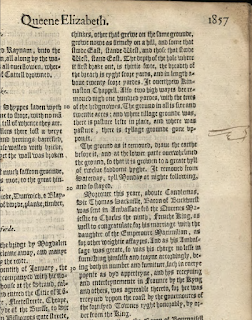
The University of Kansas' Kenneth Spencer Research Library has a copy of the 1577 first edition of Holinshed's Chronicles. Please visit their website for a complete description of this book and its provenance. Here is the auction notice of the book.

The Killigrew Family Connection with Henry Neville
The book has the name William Killigrew written on the title page. William Killigrew was the younger brother of Henry Killigrew; Henry Killigrew was the father of Anne Killigrew Neville, the wife of Henry Neville.
When Henry Neville sent letters from London, he often signed them from "Lothbury." That is where William Killigrew lived; whether Henry Neville stayed with William (his wife's uncle) or Henry (his wife's father) is unclear. This needs further research. In either case, he certainly could have had access to William Killigrew's library staying in Lothbury.
This is the first edition of the book; it is conventional wisdom that the author of the works of Shakespeare used the 1587, second edition of the book. However, it is very possible that the author actually consulted both editions. It is worth noting that Henry Killigrew was one of the three people chosen to review and censor the second edition of the book before it was published.
Several sections of this copy are annotated. They seem to have a close connection with the works of Shakespeare.
King John
On page 559, in the section on King John, there is a manicule pointing to this text (spelling modernized):
About this time, Queen Eleanor the mother of King John departed this life, consumed rather through sorrow and anguish of mind than of any other natural infirmity.
Queen Elinor was a key character in the play King John and her death is mentioned.
There is a mark also next to this text on the same page, describing a fish man (the so-called Wild Man of Orford) :
A fish was taken by fishers in their nets as they were at sea, resembling in shape a wild or savage man.
This is language quite similar to the description of Caliban in The Tempest, 2.2:
What have we here? a man or a fish? dead or alive? A fish: he smells like a fish; a very ancient and fish-like smell.

Henry VI, Part I
Most importantly, on page 1239, in the section on Henry VI, this text has a mark:
After this, the Earl caused certain Bulwarks to be made round the town, casting trenches between the one and the other, laying ordnance in every place where he saw that any battery might be devised.

Compare to Shakespeare, Henry VI, Part I, 1.4:
But now thou shalt not. Be thou ruled by me:
Chief master-gunner am I of this town;
Something I must do to procure me grace.
The prince's espials have informed me
How the English, in the suburbs close intrench'd,
Wont, through a secret grate of iron bars
In yonder tower, to overpeer the city,
And thence discover how with most advantage
They may vex us with shot, or with assault.
To intercept this inconvenience,
A piece of ordnance 'gainst it I have placed;
And even these three days have I watch'd,
If I could see them.
Now do thou watch, for I can stay no longer.
If thou spy'st any, run and bring me word;
And thou shalt find me at the governor's.
The Wikipedia entry for Henry VI, Part I, explains that this section of the play is taken directly from Holinshed's Chronicles, even though much of the play is taken from Hall's Chronicle:
Another piece of information unique to Holinshed occurs when the Master Gunner mentions that the English have taken control of some of the suburbs of Orléans (1.4.2). Holinshed reports that the English captured several of the suburbs on the other side of the Loire, something not found in Hall.
Since there are so few annotations in the book, this mark on a passage that is directly reflected in Henry VI, Part I is particularly noteworthy.
This section about Henry VI is also marked:

The 1571 Earthquake
The book also has a mark on the section of Queen Elizabeth that deals with the earthquake in Herefordshire February 17, 1571:

Neville and Iron Ordnance
Fans of this blog know I have series of posts called Cannons in the Canon detailing how Neville's experiences as a manufacturer of iron ordnance influenced the works of Shakespeare. This is a prime example of such synergy. The highlighted section in Holinshed's Chronicle -- and in the play Henry VI, Part I -- deal with ordnance explicitly. It was Neville's interest at the time and its reflected in his play writing.
Connection with Thomas Killigrew
Thomas Killigrew was a dramatist and theater manage and the grandson of William Killigrew. His father, Robert Killigrew, was very closely connected to Henry Neville; Neville explicitly mentions Robert in his will. Thomas owned a copy of Shakespeare's First Folio; it is currently at Meisei University in Tokyo.
Wednesday, May 22, 2019
Is There a Shakespeare Authorship Question?
Recently an outstanding Shakespeare scholar has suggested to me that there is no Shakespeare Authorship Question. Here are a few possible ways to interpret that suggestion, and my responses:
1. It doesn't matter who wrote the works of Shakespeare; the works should be evaluated on their own terms, without regard to authorship. Any biographical readings, even if we know for certain the author's identity, aren't likely to enrich our understanding of the works. "Shakespeare" IS the works of Shakespeare. Nothing else should concern us.
This is the current, default interpretation of the works of Shakespeare. The biography of William Shakespeare offers no insights into the works themselves, so it is almost universally ignored. This has pretty much always been the case, and it is the case today. Fanciful biographies have been produced for generations, but the bulk of scholarship over the past 100+ years largely disregards William Shakespeare the individual.
Biographical readings also tend to lead people away from the texts themselves, causing confusion and often not adding a lot of insight. A good example is guessing games about the intent of John Donne's poems. Even though a lot is known about his life -- and no one doubts his authorship -- biographical interpretations of his poems really aren't fruitful. It is also likely true that works of that period were less autobiographical than more recent literature.
However, the Shakespeare Authorship Question is a question of historical fact. Some single person put pen to paper and wrote most or all of the Shakespeare canon. That single person must have accessed and read the sources of Shakespeare's works. That person must have known the vocabulary used and the facts described. That person must have been alive when the works of Shakespeare were being written. That person must have had the motivation -- whatever that might have been -- to write those specific works at the specific times they were written.
Through careful historical research we very well may be able determine who that person was. The main problem up until now is that wrong Authorship Candidates have been suggested (Oxford, Marlowe, etc.) What has been provided as "evidence" for these candidates hasn't been evidence at all. This has confused the situation, and led people to abandon hope of ever resolving this question.
Failures of the past don't mean the question should be abandoned. It means that people need to adopt higher standards of facts and evidence. They need to assess the facts first and then see if it fits potential authorship candidates, rather than distorting facts to fit their favorite candidate.
Note, even if we discover the solution to the Authorship Question, that probably won't greatly alter our interpretation or understanding of the works themselves. But that doesn't invalidate the need for historical research into this question. Facts are facts and we ought to discover them as best we can.
2. The evidence is so overwhelming that William Shakespeare of Stratford wrote all or most of the plays and poems attributed to him, any discussion of a Shakespeare Authorship Question is ridiculous.
My interest is in original research, not fighting the same battles that haven't changed for 150 years. But the facts and evidence do not support this whatsoever. There is shockingly little evidence that William Shakespeare wrote anything, let alone 36+ plays and three books of poetry. The works were, of course, attributed to him. He also appears to have been a member of the acting company that produced the plays. But there is no plausible theory of how he could have written them, and there is no agreement among the implausible theories. This falls far short of conclusive proof, especially with all of the contradictory evidence.
3. The Shakespeare Authorship Debate is bad for everyone. It hurts Shakespeare studies; it takes time and resources away from more important pursuits. It is a distraction. So it should be abandoned.
Scholarship is about finding out the truth. That is the whole point. Research should follow the highest standards, but it shouldn't be restrained in this way. Free inquiry is the way that we learn new, unexpected, and important things. Stifling it is bad for everyone.
Denying the Shakespeare Authorship Question will not make it go away. Punishing and shunning people for engaging in this research has indeed discouraged it in academia. But with the current digital tools available to everyone all over the world, more and more independent researchers will be working on this issue. There is no way to stop it.
Fortunately, we are way way closer to solving this question than people realize. The correct candidate has been identified: Henry Neville. My new research will show the path to completely resolving the question once and for all. Stay tuned!
1. It doesn't matter who wrote the works of Shakespeare; the works should be evaluated on their own terms, without regard to authorship. Any biographical readings, even if we know for certain the author's identity, aren't likely to enrich our understanding of the works. "Shakespeare" IS the works of Shakespeare. Nothing else should concern us.
This is the current, default interpretation of the works of Shakespeare. The biography of William Shakespeare offers no insights into the works themselves, so it is almost universally ignored. This has pretty much always been the case, and it is the case today. Fanciful biographies have been produced for generations, but the bulk of scholarship over the past 100+ years largely disregards William Shakespeare the individual.
Biographical readings also tend to lead people away from the texts themselves, causing confusion and often not adding a lot of insight. A good example is guessing games about the intent of John Donne's poems. Even though a lot is known about his life -- and no one doubts his authorship -- biographical interpretations of his poems really aren't fruitful. It is also likely true that works of that period were less autobiographical than more recent literature.
However, the Shakespeare Authorship Question is a question of historical fact. Some single person put pen to paper and wrote most or all of the Shakespeare canon. That single person must have accessed and read the sources of Shakespeare's works. That person must have known the vocabulary used and the facts described. That person must have been alive when the works of Shakespeare were being written. That person must have had the motivation -- whatever that might have been -- to write those specific works at the specific times they were written.
Through careful historical research we very well may be able determine who that person was. The main problem up until now is that wrong Authorship Candidates have been suggested (Oxford, Marlowe, etc.) What has been provided as "evidence" for these candidates hasn't been evidence at all. This has confused the situation, and led people to abandon hope of ever resolving this question.
Failures of the past don't mean the question should be abandoned. It means that people need to adopt higher standards of facts and evidence. They need to assess the facts first and then see if it fits potential authorship candidates, rather than distorting facts to fit their favorite candidate.
Note, even if we discover the solution to the Authorship Question, that probably won't greatly alter our interpretation or understanding of the works themselves. But that doesn't invalidate the need for historical research into this question. Facts are facts and we ought to discover them as best we can.
2. The evidence is so overwhelming that William Shakespeare of Stratford wrote all or most of the plays and poems attributed to him, any discussion of a Shakespeare Authorship Question is ridiculous.
My interest is in original research, not fighting the same battles that haven't changed for 150 years. But the facts and evidence do not support this whatsoever. There is shockingly little evidence that William Shakespeare wrote anything, let alone 36+ plays and three books of poetry. The works were, of course, attributed to him. He also appears to have been a member of the acting company that produced the plays. But there is no plausible theory of how he could have written them, and there is no agreement among the implausible theories. This falls far short of conclusive proof, especially with all of the contradictory evidence.
3. The Shakespeare Authorship Debate is bad for everyone. It hurts Shakespeare studies; it takes time and resources away from more important pursuits. It is a distraction. So it should be abandoned.
Scholarship is about finding out the truth. That is the whole point. Research should follow the highest standards, but it shouldn't be restrained in this way. Free inquiry is the way that we learn new, unexpected, and important things. Stifling it is bad for everyone.
Denying the Shakespeare Authorship Question will not make it go away. Punishing and shunning people for engaging in this research has indeed discouraged it in academia. But with the current digital tools available to everyone all over the world, more and more independent researchers will be working on this issue. There is no way to stop it.
Fortunately, we are way way closer to solving this question than people realize. The correct candidate has been identified: Henry Neville. My new research will show the path to completely resolving the question once and for all. Stay tuned!
Wednesday, May 15, 2019
New Words in Hamlet
So in preparation for my upcoming book, I have been doing extensive research and experiments using Pervez Rizvi's database of 527 early modern English plays. Loading the data into a MySQL database makes it into an incredibly valuable research tool. He has done a great service by making this database available for anyone to use.
A key emphasis of my research is studying the vocabulary usage across plays. Here I have done a search of the "lemmas" (simplified, dictionary headword versions of words) that appear in Hamlet but do not appear in any previous plays. So it's essentially a list of the new vocabulary items that first appear in Hamlet. This is just the raw result; there may be errors or omissions based on the lemmatization, etc. It also doesn't include the poems, this is a search only on plays. So some of these words may appear in Venus and Adonis or Rape of Lucrece. But it's still a very interesting list!
abstinence
acquire
adjoin
affront
allowance
altitude
ambiguous
ankle
annexment
anticipation
apoplex
ardour
argal
arraign
artery
artless
attent
audit
auspicious
barnardo
bat
batten
benet
berattle
bernardo
betoken
bisson
blastment
blench
bloat
bodiless
bourn
brainish
brute
bunghole
buyer
buzzer
bye
calumnious
calumny
capability
casual
cataplasm
cautel
caution
caviar
cellarage
cerement
chanson
chary
cherub
chopine
circumvent
clemency
climature
coagulate
collateral
collection
comart
comical
comma
commeddle
commencement
commutual
comply
compost
compulsatory
compulsive
concernancy
condolement
congrue
conjunctive
consummation
contraction
contumely
convenience
cornelius
crant
crash
credent
criminal
croak
damon
dane
danish
dansker
debatement
decayer
definement
delve
delver
denmark
desperation
diameter
dicer
diction
dild
disappoint
disaster
dismantle
distilment
ditcher
document
dozy
drossy
dup
easiness
eastward
eggshell
eisel
elsinore
emphasis
enacture
encompassment
encumber
engineer
enseam
entreatment
equivocation
es
escote
eterne
excitement
expectance
extolment
fardel
fatness
felly
fishmonger
fitness
flagon
flaxen
flush
fortinbras
frock
fust
garbage
germane
gertrude
gibber
glare
glimpse
gonzago
graveness
grope
groundling
guildenstern
gules
hamlet
harrow
hatchment
headshake
hebona
hectic
hent
herods
hillo
historical
hoodman
horatio
hugger
illo
illume
impartment
impaste
impiteous
implement
implorator
importunate
impostume
impotence
incest
incestuous
incontinency
incorporal
incorpse
incorrect
indict
indiscretion
individable
inexplicable
infusion
inhibition
inoculate
instrumental
inventor
inventorial
israel
jawbone
jelly
jointress
kettle
kettledrum
kindless
laboursome
lamord
leaven
leprous
lewdness
loan
loggat
loneliness
lucianus
machine
malefaction
malicho
mandate
marcellus
matin
mazzard
miching
mildew
milky
mine
mineral
miraculous
mobled
mortise
mousetrap
mugger
nerve
neutral
niobe
northerly
norway
noyance
nunnery
nutshell
observant
occult
occurrent
offendo
omen
operant
ophelia
oppressor
ordinant
ore
origin
osric
ossa
outbreak
overcrow
overdo
overgrowth
overhasty
overstep
overtop
overweigh
paddle
paddock
pah
pall
palmy
pansy
pastor
pastoral
peculiar
pendant
permanent
perturb
perusal
petard
pickax
pious
plausive
plautus
pleurisy
pocky
poem
poisoner
polack
polonius
ponderous
portraiture
potency
precede
precurse
prenominate
presentment
pressure
prettiness
primal
primy
proposer
provincial
puh
purport
pursy
pyrrhus
quarry
questionable
quickness
quietus
quillity
ratifier
real
recognizance
reconcilement
rede
redeliver
relative
repel
repugnant
requiem
respeak
responsive
retrograde
revisit
reword
reynaldo
rhapsody
rosencrantz
rummage
salary
sanctuarize
sanity
sate
satirical
satyr
savageness
saviour
savoury
schoolfellow
screen
scrimer
se
select
seneca
shard
shark
shatter
sheepskin
shipwright
shred
signet
skyish
sled
sleeper's
sliver
solidity
southerly
spectator
spendthrift
splenitive
springe
squeeze
stallion
station
statist
stithy
stow
strewment
sulphurous
sultry
summit
suppliance
supposal
survivor
suspiration
swinish
swisser
swoopstake
tan
temperance
tenable
test
tether
tetter
thereunto
tinct
total
traduce
tropical
truepenny
truster
turbulent
tweak
tyrannical
ubique
ulcer
ulcerous
umbrage
unaneled
uncharge
unction
uneffectual
unfellowed
unfledged
unforced
unfortified
ungored
unhand
unhouseled
unimproved
unknowing
unlimited
unmask
unmastered
unmixed
unnerved
unpack
unpeg
unpolluted
unpregnant
unprevailing
unproportioned
unreclaimed
unrighteous
unripe
unsanctified
unshake
unshape
unsifted
unsmirched
unused
unwatched
unweeded
unwring
uphoard
upspring
vanquisher
ventage
vienna
voltemand
voucher
waterfly
weedy
wharf
wheaten
whensoever
whiff
wick
windlass
wittenberg
woundless
yaw
yeasty
yorick
zone
A key emphasis of my research is studying the vocabulary usage across plays. Here I have done a search of the "lemmas" (simplified, dictionary headword versions of words) that appear in Hamlet but do not appear in any previous plays. So it's essentially a list of the new vocabulary items that first appear in Hamlet. This is just the raw result; there may be errors or omissions based on the lemmatization, etc. It also doesn't include the poems, this is a search only on plays. So some of these words may appear in Venus and Adonis or Rape of Lucrece. But it's still a very interesting list!
abstinence
acquire
adjoin
affront
allowance
altitude
ambiguous
ankle
annexment
anticipation
apoplex
ardour
argal
arraign
artery
artless
attent
audit
auspicious
barnardo
bat
batten
benet
berattle
bernardo
betoken
bisson
blastment
blench
bloat
bodiless
bourn
brainish
brute
bunghole
buyer
buzzer
bye
calumnious
calumny
capability
casual
cataplasm
cautel
caution
caviar
cellarage
cerement
chanson
chary
cherub
chopine
circumvent
clemency
climature
coagulate
collateral
collection
comart
comical
comma
commeddle
commencement
commutual
comply
compost
compulsatory
compulsive
concernancy
condolement
congrue
conjunctive
consummation
contraction
contumely
convenience
cornelius
crant
crash
credent
criminal
croak
damon
dane
danish
dansker
debatement
decayer
definement
delve
delver
denmark
desperation
diameter
dicer
diction
dild
disappoint
disaster
dismantle
distilment
ditcher
document
dozy
drossy
dup
easiness
eastward
eggshell
eisel
elsinore
emphasis
enacture
encompassment
encumber
engineer
enseam
entreatment
equivocation
es
escote
eterne
excitement
expectance
extolment
fardel
fatness
felly
fishmonger
fitness
flagon
flaxen
flush
fortinbras
frock
fust
garbage
germane
gertrude
gibber
glare
glimpse
gonzago
graveness
grope
groundling
guildenstern
gules
hamlet
harrow
hatchment
headshake
hebona
hectic
hent
herods
hillo
historical
hoodman
horatio
hugger
illo
illume
impartment
impaste
impiteous
implement
implorator
importunate
impostume
impotence
incest
incestuous
incontinency
incorporal
incorpse
incorrect
indict
indiscretion
individable
inexplicable
infusion
inhibition
inoculate
instrumental
inventor
inventorial
israel
jawbone
jelly
jointress
kettle
kettledrum
kindless
laboursome
lamord
leaven
leprous
lewdness
loan
loggat
loneliness
lucianus
machine
malefaction
malicho
mandate
marcellus
matin
mazzard
miching
mildew
milky
mine
mineral
miraculous
mobled
mortise
mousetrap
mugger
nerve
neutral
niobe
northerly
norway
noyance
nunnery
nutshell
observant
occult
occurrent
offendo
omen
operant
ophelia
oppressor
ordinant
ore
origin
osric
ossa
outbreak
overcrow
overdo
overgrowth
overhasty
overstep
overtop
overweigh
paddle
paddock
pah
pall
palmy
pansy
pastor
pastoral
peculiar
pendant
permanent
perturb
perusal
petard
pickax
pious
plausive
plautus
pleurisy
pocky
poem
poisoner
polack
polonius
ponderous
portraiture
potency
precede
precurse
prenominate
presentment
pressure
prettiness
primal
primy
proposer
provincial
puh
purport
pursy
pyrrhus
quarry
questionable
quickness
quietus
quillity
ratifier
real
recognizance
reconcilement
rede
redeliver
relative
repel
repugnant
requiem
respeak
responsive
retrograde
revisit
reword
reynaldo
rhapsody
rosencrantz
rummage
salary
sanctuarize
sanity
sate
satirical
satyr
savageness
saviour
savoury
schoolfellow
screen
scrimer
se
select
seneca
shard
shark
shatter
sheepskin
shipwright
shred
signet
skyish
sled
sleeper's
sliver
solidity
southerly
spectator
spendthrift
splenitive
springe
squeeze
stallion
station
statist
stithy
stow
strewment
sulphurous
sultry
summit
suppliance
supposal
survivor
suspiration
swinish
swisser
swoopstake
tan
temperance
tenable
test
tether
tetter
thereunto
tinct
total
traduce
tropical
truepenny
truster
turbulent
tweak
tyrannical
ubique
ulcer
ulcerous
umbrage
unaneled
uncharge
unction
uneffectual
unfellowed
unfledged
unforced
unfortified
ungored
unhand
unhouseled
unimproved
unknowing
unlimited
unmask
unmastered
unmixed
unnerved
unpack
unpeg
unpolluted
unpregnant
unprevailing
unproportioned
unreclaimed
unrighteous
unripe
unsanctified
unshake
unshape
unsifted
unsmirched
unused
unwatched
unweeded
unwring
uphoard
upspring
vanquisher
ventage
vienna
voltemand
voucher
waterfly
weedy
wharf
wheaten
whensoever
whiff
wick
windlass
wittenberg
woundless
yaw
yeasty
yorick
zone
Was Shakespeare a Woman? A few thoughts
Elizabeth Winkler set the world ablaze with her article Was Shakespeare a Woman in The Atlantic Monthly. A few key points.
1. The article is probably the best-written piece ever on the Shakespeare Authorship Question. It's also incredibly accurate in the details; I can't really quibble with the factual accuracy of anything in the article.
2. The reaction to the article has been fascinating to watch. The "big names" in Shakespeare apologetics have largely remained silent or dismissed it casually. They've figured out that defending Shakespeare, since their defense is so weak, doesn't help their cause. Better to just dismiss attacks rather than engaging.
3. The evidence for Emilia Bassano Lanier (Lanyer)'s authorship is extremely light. In fact, there's really no reason at all to think she wrote the works of Shakespeare. The evidence about her family names appearing in the plays certainly could be something real, but it doesn't imply authorship. She really was too young to have written the plays/poems and lived way too long after. In addition, her poetry just isn't like Shakespeare's. There's no way the author of Shakespeare's works wrote these poems in 1611.
4. Obviously, I think that Henry Neville wrote the works of Shakespeare, so I don't think a woman wrote the works of Shakespeare. However, it is very likely that Henry Neville's wife, Anne Killigrew Neville, was in some ways involved in the works of Shakespeare. We will probably never know all of the details, but she was a highly educated woman and may have played a substantial role.
1. The article is probably the best-written piece ever on the Shakespeare Authorship Question. It's also incredibly accurate in the details; I can't really quibble with the factual accuracy of anything in the article.
2. The reaction to the article has been fascinating to watch. The "big names" in Shakespeare apologetics have largely remained silent or dismissed it casually. They've figured out that defending Shakespeare, since their defense is so weak, doesn't help their cause. Better to just dismiss attacks rather than engaging.
3. The evidence for Emilia Bassano Lanier (Lanyer)'s authorship is extremely light. In fact, there's really no reason at all to think she wrote the works of Shakespeare. The evidence about her family names appearing in the plays certainly could be something real, but it doesn't imply authorship. She really was too young to have written the plays/poems and lived way too long after. In addition, her poetry just isn't like Shakespeare's. There's no way the author of Shakespeare's works wrote these poems in 1611.
4. Obviously, I think that Henry Neville wrote the works of Shakespeare, so I don't think a woman wrote the works of Shakespeare. However, it is very likely that Henry Neville's wife, Anne Killigrew Neville, was in some ways involved in the works of Shakespeare. We will probably never know all of the details, but she was a highly educated woman and may have played a substantial role.
Sunday, March 3, 2019
Learning French with Henry Neville
So the son of Richard Carew went to France with Henry Neville when Neville went there as ambassador in 1599. He talks about it in this book about learning Latin:
https://quod.lib.umich.edu/e/eebo/A42982.0001.001/1:5?rgn=div1;view=fulltext
After my return and short staying here I was sent by my Father into France with Sir Henry-Nevill, who was then Ambassadour Leiger unto Henry the Fourth, that there I might learn the French Tongue, which Language, though it seemed very hard to me in the beginning, because mine ignorant made me unable to distinguish one word from another, and so imagine that those people used to talk much faster then we did.
In a little time, when by often-hearing their talk, I began to discern the distance of one word from another, I found they used to talk rather more deliberately then we do; and so by reading and talking, I learn'd more French in three quarters of a year then I had done Latin in above thirteen.
https://quod.lib.umich.edu/e/eebo/A42982.0001.001/1:5?rgn=div1;view=fulltext
After my return and short staying here I was sent by my Father into France with Sir Henry-Nevill, who was then Ambassadour Leiger unto Henry the Fourth, that there I might learn the French Tongue, which Language, though it seemed very hard to me in the beginning, because mine ignorant made me unable to distinguish one word from another, and so imagine that those people used to talk much faster then we did.
In a little time, when by often-hearing their talk, I began to discern the distance of one word from another, I found they used to talk rather more deliberately then we do; and so by reading and talking, I learn'd more French in three quarters of a year then I had done Latin in above thirteen.
Subscribe to:
Posts (Atom)