Showing posts with label Billingbear Book List. Show all posts

Monday, September 9, 2019

My Discovery of Neville's Library and Shakespeare Research

I'd like to explain why my discovery of the 1780 catalog of books from Billingbear is such an important milestone in Shakespeare authorship research. You can see my blog post describing the main Shakespeare sources listed in the catalog as well as one focused on politics and political philosophy.


Source Texts are a Key Issue in Shakespeare Authorship Research

Scholars have carefully identified the source texts that must have been  used in the creation of the works of Shakespeare. Those sources include many books in Latin, Italian and French that had not  been translated into English in Shakespeare's time. No plausible explanation has ever been offered of how William Shakespeare might have acquired the language skills to read those books.

In addition,  even though Shakespeare was wealthy, no evidence has ever been found of him owning any books at all. This is in contrast to contemporaries like Ben Jonson or John Donne who left behind large libraries. Since the works of Shakespeare demonstrate familiarity with such a wide variety of literature, this is a glaring anomaly. Perhaps more than anything else, this incongruity has given rise to the Shakespeare Authorship Question.

How the Billingbear Book List Matches Shakespeare's Known Sources

There is a truly extraordinary correspondence between known Shakespeare sources and the Billingbear book list. Most striking of all is Cinthio's Gli Hecatommithi, a text that wasn't commonly read in England at the time but was the source of both Othello and Measure for Measure. Other important texts include Boccaccio's Decameron, Chaucer's Works, the Latin source text for Hamlet, Orlando Furioso, and many other works of history and philosophy that have been identified as likely sources for Shakespeare.

It's not just the major sources that are listed. The list includes many books on Italian history and politics that align very closely with the topics of Shakespeare's Italian plays. In almost every respect, this is the library you would expect from the author of the works of Shakespeare.

Dating the Source Texts to Henry Neville

Almost all of the source texts were printed in 1581 or before. This is extremely strong evidence that they were, in fact, owned by Henry Neville. Neville traveled in Italy around 1579-81. For example, Gli Hecatommithi and Orlando Furioso are both 1580 printings. So it is very likely that he purchased books during his travels and shipped them home to England.

Some of the volumes are currently at Audley End, but most are not. It may very well be possible to locate some of these volumes to inspect them to offer further confirmation of Neville's ownership.

A New Chapter in Shakespeare Authorship Research

This is the most powerful documentary evidence ever demonstrated for a Shakespeare Authorship Candidate. It is also important for Shakespeare research. Up until now, research into Shakespeare's sources has always been limited to analyzing the plays and poems for clues. Now, we can analyze this book catalog and see how and when the books were incorporated into or referenced by Shakespeare's works.

Questions Answered:

How did you discover the book catalog?

I've known about the catalog since December 2018. In March I ordered copies of 5 out of the 44 pages of the catalog, but it wasn't until August 27, 2019 that I was able to visit the Berkshire Record Office in person and see the entire catalog.

Did previous Neville researchers examine the catalog?

As far as I can tell, no. Neville researchers have examined the books at Audley End, and so have seen some of the books listed in the catalog. But many of the most important Shakespeare sources are not at Audley End; they are only listed in the catalog.

If the books aren't at Audley End, where are they?

I don't know. Locating all of the books in the catalog is an important next step. It should provide many additional clues to how Henry Neville wrote the works of Shakespeare.

Could someone much later have tried to recreate Shakespeare's library?

Many of the books in the catalog are directly connected to Henry Neville. The dates also are very early. If someone in the 1700s wanted to recreate Shakespeare's library, there would be no need to acquire pre-1580 books. Henry Neville, however, was travelling in Europe in 1580-81 so it makes sense for the title to date to that era.

Anything is possible, but it seems more likely that the early books were simply purchased by Henry Neville at the time. The Neville family lived continuously at Billingbear from Neville's life and there are many books in the library we can identify as certainly belonging to Henry Neville.


Friday, September 6, 2019

Henry Neville's Library, Political Philosophy, and Shakespeare

Henry Neville's deep and abiding interest in good governance and political philosophy is one of the strongest pieces of evidence for his authorship of the works of Shakespeare. Shakespeare's plays touch on these themes over and over again, from the Henry VI plays to Coriolanus. There is a vast literature on -- and endless speculation about -- which books of political philosophy Shakespeare might have read.

My discovery of Henry Neville's Book Catalog offers us an entirely new way to examine Shakespeare sources. Instead of just looking at the plays and poems and trying to guess which sources might have been consulted, now we can look at a library of books and see which correspond with the ideas expressed in Shakespeare's works.

I want to highlight three entries in the library catalog, all of which have dependently been identified as possible Shakespeare sources: Machiavelli's The Prince, Jean Bodin's Les Six livres de la République (The Six Books of the Republic)  and Giovanni Botero's Della ragion di Stato (The Reason of State).

Machiavelli's The Prince

Henry Neville had a 1551 edition of The Prince, here is the USTC Entry.


Here is the title page for a very similar edition you can view online at Google Books:


Shakespeare specifically references Machiavelli in three plays, so whoever wrote the works of Shakespeare was familiar with Machiavelli from at least 1591, if not earlier:

Alencon! that notorious Machiavel!
It dies, an if it had a thousand lives. - Henry VI, Part I, 5.4

Change shapes with Proteus for advantages,
And set the murderous Machiavel to school. - Henry VI, Part III, 3.2

Peace, I say! hear mine host of the Garter. Am I
politic? am I subtle? am I a Machiavel? - Merry Wives of Windsor, 3.1

There is a vast literature on Shakespeare and Machiavelli. Here is an article from the British Library on Machiavelli and Richard III. Hugh Grady's Shakespeare, Machiavelli, and Montaigne deals with these issues in-depth. Here is evidence from Richard II showing Shakespeare likely read Machiavelli. I could offer dozens more references.

Jean Bodin's The Six Books of the Republic

Henry Neville had a 1579 copy of Jean Bodin's Les six livres de la republique, here is the USTC Entry.


You can view a likely similar, 1580 edition on Google Books:


For discussion of Shakespeare's response to Bodin, see Campana's The Child’s Two Bodies: Shakespeare, Sovereignty, and the End of Succession, Lopez's Trespass and Forgiveness in William Shakespeare’s King Lear. DiMatteo's Shakespeare and the Public Discourse of Sovereignty: “Reason of State” in Hamlet, and Hadfield's Shakespeare and Renaissance Politics.

These references to Bodin take on a new meaning if we consider the possibility that the author of the works of Shakespeare owned a copy of The Six Books of the Republic. This is why Shakespeare Authorship Research is so important for Shakespeare scholarship.

Giovanni Botero's The Reason of State

Henry Neville had a 1589 copy of Botero's The Reason of State. Here is the USTC Entry.


You can view this 1589 edition on Archive.org.


See the Oxford Handbook of the Age of Shakespeare for a discussion of this book and Shakespeare. This article by Bragantini suggests that Measure for Measure may demonstrates a first-hand knowledge of Botero.

Summary

The discovery of this library catalog opens up many new possibilities for Shakespeare research. Up until now, it has been assumed that the author of the works of Shakespeare could not read Italian and French. Now we have strong evidence that not only could he read Italian and French, there are specific books that he likely read. This creates a whole new line of research in Shakespeare studies and validates the many scholars who have already noticed strong correspondences between Shakespeare and these works.

Saturday, August 31, 2019

Henry Neville's Library of Shakespeare Sources

[Update 10/24/2019: Steadily, I am publishing the complete book list with links to the specific edition of each book. Check out the Henry Neville Research Wiki for more.]

Scholars have carefully traced the sources used in the creation of the works of Shakespeare. Dozens of books have been identified in English, Latin, Italian, and French which the author of the works of Shakespeare must have read.

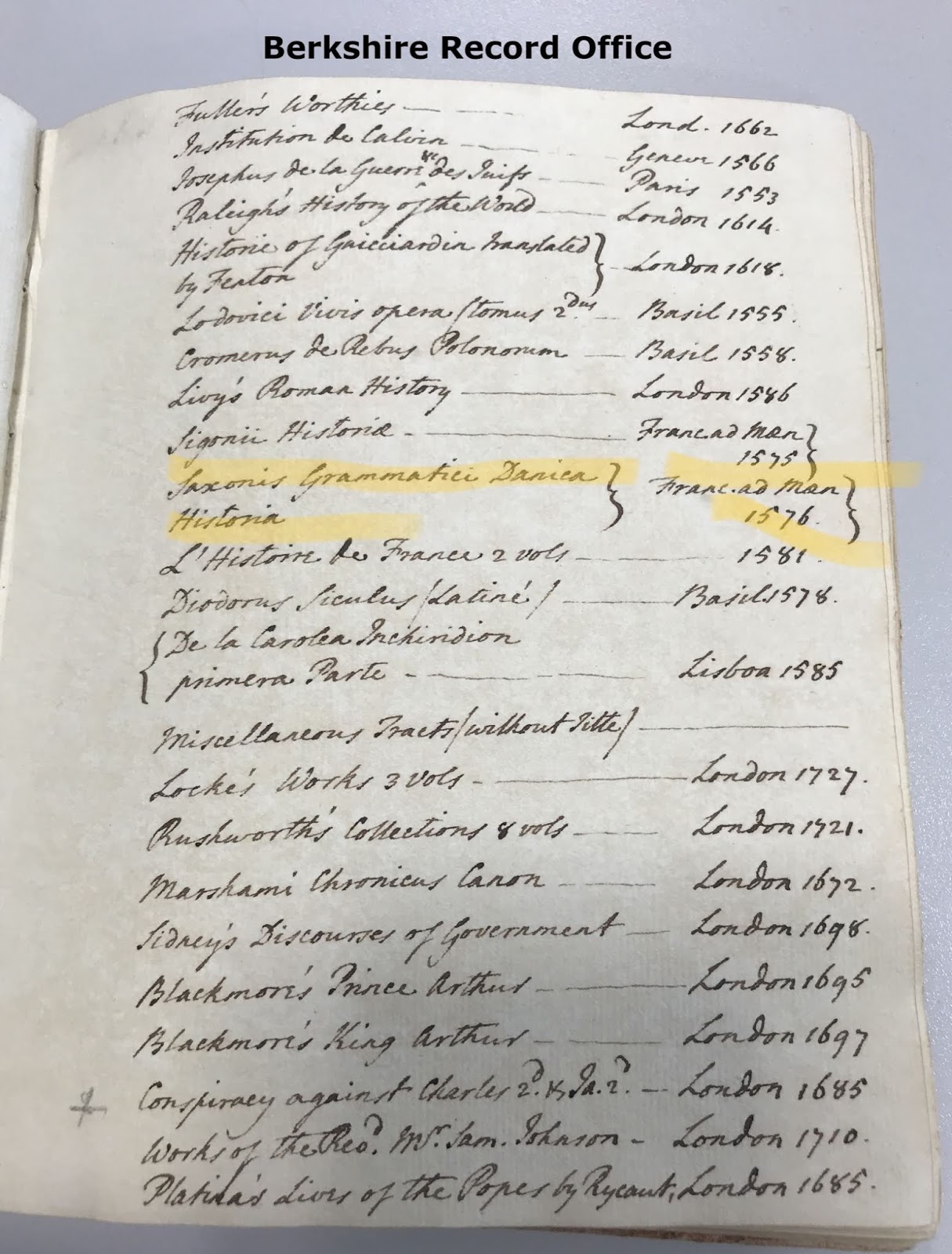
Henry Neville (1563-1615) left behind a large library. In 1780, a catalog was made of the books at his home at Billingbear. Examining that list shows an extraordinary correlation with the sources used by Shakespeare. Some of these books are currently at Audley End.

I visited the Berkshire Record Office last week and photographed this catalog. With their permission, I will highlight some of the most interesting connections between that catalog and the works of Shakespeare.


Source texts are one of the most reliable means to determine authorship. Only someone who had access to -- and could read -- the source texts could have written the works of Shakespeare. The alignment between Shakespeare's sources and Neville's library provides strong evidence supporting his authorship.


Othello and Measure for Measure - Cinthio's Gli Hecatommithi

This article from the British Library gives a good overview of how the plays Othello and Measure for Measure are based on Cinthio's Gli Hecatommithi. Henry Neville owned a 1580 edition of the book:


Here is the cover page of the edition cited in the above Billingbear catalog entry:


Unfortunately, this book doesn't appear to currently be at Audley End. This book, in Italian, was not widely read in England at the time. It is quite an extraordinary coincidence that Henry Neville owned this book which was the main source of two Shakespeare plays.

Hamlet - Saxonis Grammatici Danica Historia

This Latin book, also called the Gesta Danorum, is the ultimate source for Hamlet. The British Library has an excellent description of the book's connection with Hamlet.


This is the cover page of the edition of the book listed in the catalog, you can read it on Google Books:


Here is the Wikipedia entry for Gesta Danorum, it discusses in detail the editions of the book and its relation to Hamlet.

All's Well that Ends Well and Cymbeline - Boccaccio's Decameron

Henry Neville seems to have owned two copies of Boccaccio's Decameron, 1527 and 1555, and it is a major source for the works of Shakespeare.


Here is  Wikipedia on All's Well that Ends Well:

"The play is based on a tale (tale nine of day three) of Boccaccio's The Decameron."

Here is Wikipedia on Cymbeline:

"The subplot of Posthumus and Iachimo's wager derives from story II.9 of Giovanni Boccaccio's The Decameron and the anonymously authored Frederyke of Jennen."

Sonnet 144 also references The Decameron and The Two Gentlemen of Verona may also have used it as a source.

Much Ado About Nothing - Ludovico Ariosto's Orlando Furioso 


Here is the cover for this 1580 edition, you can read it on Google Books:


Wikipedia explains the connection with Much Ado About Nothing:

"Another version featuring lovers Ariodante and Ginevra, with the servant Dalinda impersonating Ginevra on the balcony, appears in Book V of Orlando Furioso by Ludovico Ariosto, published in an English translation in 1591. The character of Benedick too has a counterpart in a commentary upon marriage in Orlando Furioso, but the witty wooing of Beatrice and Benedick is original and very unusual in style and syncopation."

Troilus and Cressida and Two Noble Kinsmen - Chaucer's Works


Here is the cover for this 1602 edition, you can read the whole thing on Archive.org:


This edition does not appear to be at Audley End. The first edition of this book was in 1598 and Henry Neville appears to have owned the second, 1602 edition. Though Chaucer is believed to be an influence on the entire Shakespeare canon, the two major works with Chaucer as a source were written in 1602 and later:

Here is Wikipedia on the source Shakespeare's Troilus and Cressida's sources:

"The story of Troilus and Cressida is a medieval tale that is not part of Greek mythology; Shakespeare drew on a number of sources for this plotline, in particular Chaucer's version of the tale, Troilus and Criseyde, but also John Lydgate's Troy Book and Caxton's translation of the Recuyell of the Historyes of Troye."

Here is Wikipedia on the source for Shakespeare/Fletcher's Two Noble Kinsmen:

"Its plot derives from "The Knight's Tale" in Geoffrey Chaucer's The Canterbury Tales"

Hamlet and other works - Sextus Empiricus 

Sextus Empiricus was a Greek skeptic philosopher. You can read about him on Wikipedia or the Stanford Encyclopedia of Philosophy. Henry Neville had a 1569 edition of his works translated into Latin:


You can download a copy of this edition on Google Books:


There is an extensive academic literature connecting the philosophy of Sextus Empiricus with the works of Shakespeare.

For instance, in "Shakespeare and the Ten Modes of Skepticism," Robert Pierce writes: "My aim is to demonstrate some striking parallels with Pyrrhonist thought in Shakespeare's plays and poems and then to... associate  Shakespeare with scepticism as many critics have done, but in a more specific way, aiming at what is distinctively Pyrrhonist." (Shakespeare Survey, Volume 46)

See also:
Skepticism and Memory in Shakespeare and Donne by Anita Gilman Sherman.
Shakespeare's "Hamlet" and Renaissance Skepticism by Steven Jay Doloff
Rethinking Shakespeare's Skepticism by Suzanne M. Tartamella

Rape of Lucrece and Coriolanus  - Dionysius of Halicarnassus and Diodorus Siculus

Neville's library included a copy of the Latin translation of the history of  Diodorus Siculus:


Here is the title page for this edition, you can see the whole thing on Google Books:


Neville also had the 1546 edition of the history of Dionysius of Halicarnassus in Greek:


Both of these books deal with the story of the Rape of Lucrece, and are possible source material for the Shakespeare poem published in 1594.

For more information see:
Redeeming Lost Honor: Shakespeare's Rape of Lucrece

They also may have provided source material for Shakespeare's Roman plays. This may be a fruitful area for further research.

Othello - Historia della guerra fra Turchi, et Persiani

Giovanni Tommaso Minadoi's 1594 Historia della guerra fra Turchi, et Persiani is a possible source for Othello:


You can read the entire thing on Archive.org, here is the title page:


Titus Andronicus - Herodian's Roman History


Here is the title page of the 1581 Greek/Latin edition that was in Neville's library, you can read the whole thing on Google Books:


See the Wikipedia entry:

G. K. Hunter has suggested Shakespeare may have taken Saturninus' name from Herodian's History of the Empire from the Death of Marcus, which features a jealous and violent tribune named Saturninus


Summary

This is only the beginning of the connections between Neville's library and the works of Shakespeare. I will post more soon.

What is important to realize is that this book list is going to greatly expand our understanding of what constituted "Shakespeare's sources." There are many books on Italian history and politics. As scholars go through these books, they will almost certainly find echoes in Shakespeare's Italian plays. The Roman history plays also need to be re-evaluated with this book list as background.

So far we have only been able to figure out the sources for the works of Shakespeare working backwards from the plays and poems. This book list lets us move forward from source texts the author may have read, in whole or in part.