Tuesday, June 20, 2023

Examples of Henry Neville's Italic Handwriting

There has been some confusion lately about what Henry Neville's italic handwriting looked like. Neville mostly wrote using secretary hand. However, he signed his name in italic, wrote Latin in italic, and sometimes wrote placenames and people's names in italic. 

In doing handwriting comparison it is essential to find actual examples of the person's handwriting. Here are some examples that are absolutely and undeniably Henry Neville's handwriting.

Note that Neville varied his italic handwriting depending on the formality of the document. Some of the below examples are from very formal letters. Some are from personal notes to himself. The handwriting varies. Neville also varied his secretary hand depending on the formality of the document.

Note that the examples we have range from roughly 1591-1612. Some of the annotations of the books at Audley End were probably made from 1578-1582 when Neville was a teenager travelling with Savile in Europe -- or even at Oxford before they left. Some of the annotations are later for sure (the books were published later or there is other evidence). 

This letter to Thomas Windebank from February 1599 is written in Neville's informal secretary hand and has a list of names written in italic. This is a very clear example of Henry Neville's italic handwriting:


Here is a close-up of that section:


This letter from 1600 is addressed to Robert Cecil in French. It is another example of Henry Neville's italic handwriting:


Here is the full letter:

And a close-up of the date/location:

This document from 1591 has Henry Neville's scribbles on it in italic:


Here is the close-up:


This letter from 1600, written in Neville's formal secretary hand, has the location and date written in italic.


Here is the close-up:


Here is a letter Neville wrote addressed to Julius Caesar (the English judge). You can see he wrote out the name in italic:


Here is another example of a letter addressed to Julius Caesar with his name written in italic:


Here are some more examples from letters Neville wrote. These are a bit more in cursive italic:


Here is an excellent and clear example of his Latin ("dedimus potestatem") from a letter he wrote to Robert Cecil in July 1602 from the Tower of London:


Here are more examples from a 1605 letter to Thomas Windebank:


And more examples from letters to Robert Cecil:


These examples are notes that Henry Neville wrote on the back of documents while he was ambassador to France as well as some italic words he wrote in draft letters. At first glance, they might look like they were written by different people, since the handwriting varies so much. But if you look carefully, you will see that they are all actually written by the same person. Neville varied his handwriting greatly depending on circumstances.


This list of dates also includes many numbers that can be used for comparison:


Here are more examples from a postscript to a letter to Robert Cecil from 1599:


These three examples from a single letter show how handwriting can vary even within a single document. Here is the full letter:


And the three examples:


Here is a letter with many italic examples:


I've compiled them into a single image:


From a letter from 1600:


From a letter to Robert Cecil ca. 1600:


From a letter from 1606:


This is from Neville's confession in 1601:


Here are some additional examples from a draft document July 1612:


Here's another example from 1608:

More examples:


A letter from March 1601 to Winwood:


From a 1606 letter to Dudley Carleton:


From a 1600 letter to Henry Cuffe:


As anyone can see, these documents were written by the same person -- despite the variation. 

This handwriting matches perfectly the books annotated at Audley End. There are many posts on this blog about this topic. Start here with Part 1.

I believe this is an entire draft letter written in French by Henry Neville. Neville appears to have varied his handwriting depending on the language he was writing and its formality. This cursive italic was suitable for this draft letter. Unfortunately I don't have a copy of the final letter.


Monday, September 13, 2021

Possible parallel between All's Well and Microcosmos

 I noticed an interesting possible parallel between the Sonnet to Henry Neville and a passage from All's Well that Ends Well. The Sonnet appeared in the 1603 Microcosmos by John Davies of Hereford. Here it is:


The first two lines read: 

There was a Time when, ah, that so there was,

Why not there is? There is and was a Time,

Compare to this passage from All's Well that Ends Well:

This young gentlewoman had a father,—O, that 'had'! how sad a passage 'tis! (1.1.17)

There is a great deal of other research suggesting that the author of the works of Shakespeare read and was influenced by Microcosmos. See, for instance, "Shakespeare's Sonnet cxi and John Davies of Hereford's "Microcosmos" (1603)" (JSTOR).

    Brian Vickers in his 2007 book Shakespeare, A Lover’s Complaint, and John Davies of Hereford, suggests that Shakespeare “knew, and referred to” the work of John Davies of Hereford. Specifically, he suggests that this famous dialog in Macbeth:

Porter: Faith Sir, we were carousing until the second Cock: and drink, Sir, is a great provoker of three things.

Macduff: What three things does drink especially provoke?

Porter: Marry, Sir, nose-painting, sleep, and urine. (2.3.24-8)

Is derived from this description in Microcosmos:

Drink hath three; offices, The first assists

Concoction, for in it is boil'd the meat: 

The next, to mix the food the first digests: 

The Last, to bring it to the Livers heat

Much more on this to come, but just wanted to share this possible parallel.

Friday, July 9, 2021

The Greek Inscription on Henry Neville's Portrait: Solved!

Before leaving for France as ambassador in early 1599, Henry Neville had his portrait painted by Marcus Gheeraerts the Younger:


The top left of the portrait has astronomical symbols and some Greek writing:


An anonymous scholar, expert in this field, has graciously provided an explanation of the symbol and the Greek text:

The Greek, "Absolutely without prosthaphaeresis"; the latter term is used here to mean the astronomical "correction" between mean and true position. And the diagram shows the sun at apogee and perigee, depicting accurately the alternative epicycle solar model of Ptolemy, at which points the true position of the sun (the picture of the sun) and the mean position of the sun (the center of the epicycle) coincide, as seen from the center or along the line of apsides (also shown in the diagram) -- so that there is no correction, or prosthaphaeresis. 

Neville is clearly using this astronomical fact as an emblem of his directness and trustworthiness -- that there is no "correction" needed between his apparent and true self. A clever conceit!

I believe Neville here is creating a clever version of his family motto: "ne vile velis". This Latin motto is usually translated as "do nothing base or dishonorable" or  "nothing distasteful or vulgar". This Greek text, along with the astronomical symbols, seem to imply something very similar.

During their tour of Europe, Henry Neville and his tutor Henry Savile met with Paul Wittich, one of the people who developed the mathematical technique of prosthaphaeresis. Tycho Brahe also made heavy use of this method; there is a great deal of scholarship connecting the Danish Brahe with certain aspects of Hamlet. The inscription, however, emphasizes the word as used in Ptolemaic astronomy, rather than the word's use to describe the mathematical method.

Monday, May 17, 2021

Francis Windebank's First Folio?

There's a lot of excitement on Twitter. David McInnis posted an inscription from the First Folio at the State Library of New South Wales. The entire First Folio is digitized here and here. At the end of Hamlet is inscribed "Elizabeth Windebank Her Book" and at the end of Antony and Cleopatra is inscribed "The vnworthest of your seruants Tho: Hurst". Here are the full images:


Thomas Windebank was a close friend of Henry Neville and lived very close to Billingbear. There are many extant letters from Neville to Windebank, and two from his wife Anne Neville while her husband was imprisoned in the Tower.

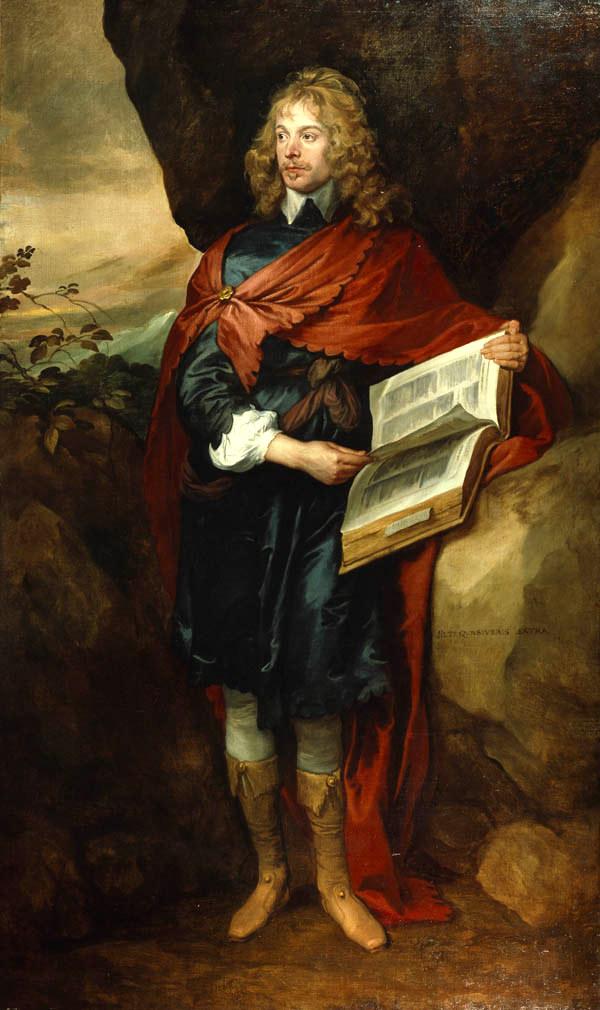
Thomas Windebank's son Francis Windebank had many literary associates, including John Florio and John Suckling. Suckling's portrait actually shows him holding a First Folio:


Francis's son Thomas (1612–1669) had a son Francis (1656–1719). And Francis was married to a woman named Elizabeth Parkhurst (1666–1730). Here is the marriage license:


Was Elizabeth Parkhurst the "Elizabeth Windebank" of the First Folio? Here is a copy of Francis (1656–1719) will mentioning his wife Elizabeth Windebank:


Could the book originally have belonged to her husband's grandfather, Francis Windebank? 

The First Folio also has some writing in secretary hand adding in Troilus and Cressida to the list of plays. Might be possible to try to match this:


This could possibly be the Thomas Hurst (Dissertation by Professor Jennine Hurl-Eamon):


Here is another possible Thomas Hurst who was murdered in 1695:

John Moare Esq ; of the Parish of St. Martins in the Fields , was Indicted for murdering one Thomas Hurst Gent. on the 21st of July last, with a Sword value 5s. and giving him one mortal Wound of the breadth of one Inch, and of the depth of Six Inches in his Breast near to his Right Pap, of which he instantly died . The Prisoner and the deceased were drinking together at the Blue Posts in the Haymarket, till about Two a Clock in the morning, and words were heard to arise between them, and the Prisoner bid him pay his Reckoning, and go his Ways. 

(There is another interesting outside possibility. John Parkhurst was another close friend of Henry Neville's. Parkhurst accompanied Neville to France as his chaplain and Neville installed him at Shellingford. So the First Folio could have descended from the Parkhurst family  to Elizabeth -- but Parkhurst was a pretty common name.)

Much more to come on this, I will update this post with more details.