Tuesday, October 22, 2019

Part 1: Shakespeare and Neville - Annotations at Audley End

(This post has grown into a series of posts. You can follow this link to see them all.)

In their book Sir Henry Neville Was Shakespeare: The Evidence, John Casson and William Rubinstein describe an annotation in a copy of Dionysius of Halicarnassus' Roman Antiquities at Audley End. The annotation relates directly to Shakespeare's Rape of Lucrece and Coriolanus.


When I first drafted this post in October 2019, I was merely exploring the possibility that this annotation was in Henry Neville's handwriting. By now (1/16/2020), with the additional research, I think we can identify this with near certainty as the handwriting of Henry Neville of Billingbear (d. 1615).

Tracing the Provenance of the Book

In 1780, a catalog was made of the books at Billingbear House, the ancestral home of the Neville family. Henry Neville's father, who died in 1593, built Billingbear House. Henry Neville grew up  there and, except for a few gaps, lived there until his death in 1615. His descendants occupied it until the 19th century.

The Billingbear Book List includes many books which Henry Neville almost certainly owned. For instance, there is a 1602 copy of Survey of Cornwall. The author, Richard Carew, was a close friend of Henry Neville's, and Neville took his son with him when he was ambassador to France. Neville's close friend John Chamber published Barlaam monachi logistice in 1600 and included a dedication to Henry Neville. That book is also on the Billingbear Book List.

Many of the books on the Billingbear Book List are currently at Audley End. They were moved there in the early 19th century. For example, the two books mentioned above are currently at Audley End.

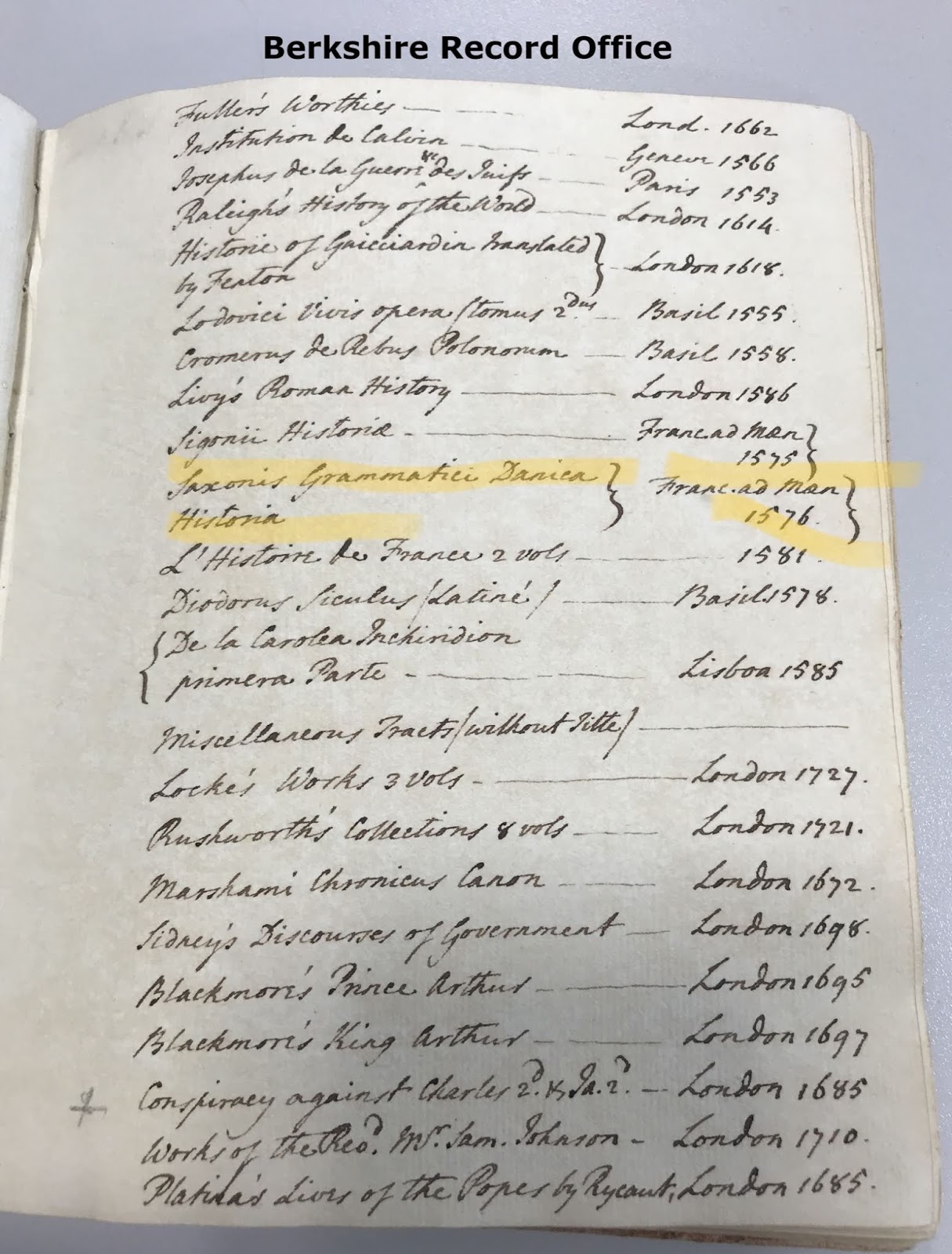
There is a 1546 edition of Dionysius of Halicarnassus' Roman Antiquities on the Billingbear Book List. The same book is currently at Audley End.  Here is the Universal Short Title Catalog Entry and you can access a full digitized version of the text. Here is the entry in the Billingbear Book List, at the top:


Here is the title page of the book:


Interestingly, Henry Savile, who was Henry Neville's tutor and lifelong friend, references precisely this edition in his 1591 translation of Tacitus:


The book is written entirely in Greek. Savile was one of the foremost experts in Greek in England at the time. During their tour of Europe, around 1579-1582, they met with local scholars and searched for Greek manuscripts.

Analyzing the Annotation and Its Connection to Shakespeare

Unfortunately, I do not have access to the entire book, but here is the annotation:


The annotation reads:
Hic omissi sunt Ancus Martius et Tarquinius Collatinus qui regnarunt annos 62 quibus adiunctis tota quadrabit computatio
Which translates (translation done by an anonymous benefactor):
Ancus Martius and Tarquinius Collatinus are omitted here, who reigned for 62 years. When these are added,the entire count of years will square
It appears on page 45 of the book, and if you look at the facsimile, it is clear that this annotation was written at the bottom left corner of that page:
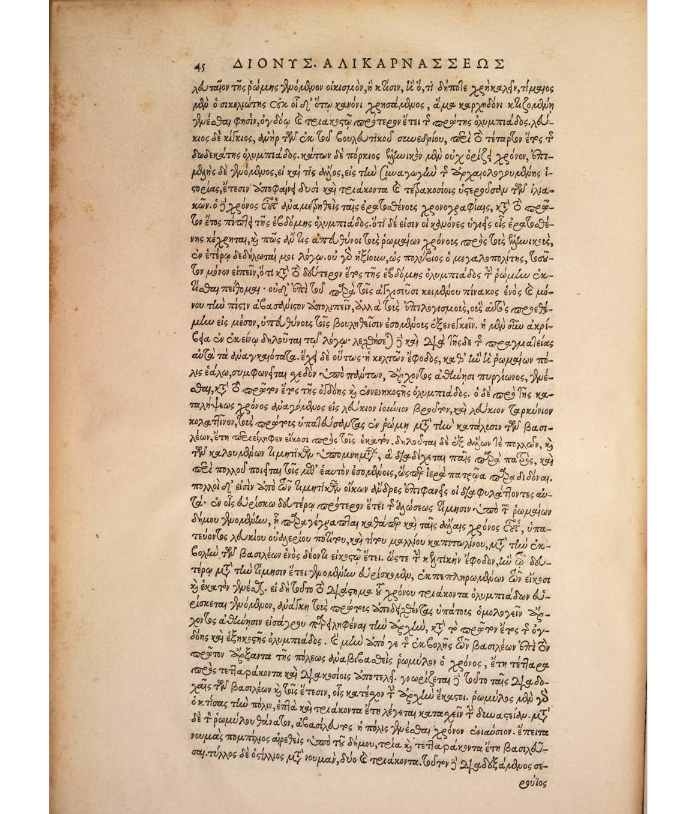

As Casson and Rubinstein explain, Collatinus is mentioned in the Argument for the Rape of Lucrece. You can read about him here in the Folger Library copy 3:


Ancus Martius is specifically mentioned in the First Folio text of Coriolanus:
The Noble House o'th' Martians: from whence came  
That Ancus Martius, Numaes Daughters Sonne: (2.3)
So this annotation relates to the works of Shakespeare quite directly. Roman Antiquities is also cited as a possible source for Coriolanus, see the Wikipedia Entry.

Here is the complete context for the annotation:
LXXV. And, again, if from the expulsion of the kings the time is reckoned back to Romulus, the first ruler of the city, it amounts to two hundred and forty-four years. This is known from the order in which the kings succeeded one another and the number of years each of them ruled. For Romulus, the founder of Rome, reigned thirty-seven years, it is said, and after his death the city was a year without a king. Then Numa Pompilius, who was chosen by the people, reigned forty-three years; after Numa, Tullus Hostilius thirty-two; and his successor, Ancus Marcius, twenty-four; after Marcius, Lucius Tarquinius, called Priscus, thirty-eight; Servius Tullius, who succeeded him, forty-four. And the slayer of Servius, Lucius Tarquinius, the tyrannical prince who, from his contempt of justice, was called Superbus, extended his reign to the twenty-fifth year. As the reigns, therefore, of the kings amount to two hundred and forty-four years or sixty-one Olympiads, it follows necessarily that Romulus, the first ruler of the city, began his reign in the first year of the seventh Olympiad, when Charops at Athens was in the first year of his ten-year term as archon.1 For the count of the years requires this; and that each king reigned the number of years stated is shown in that treatise of mine to which I have referred.
Did Henry Neville Make the Annotation?

Henry Neville mostly wrote in secretary hand, but we have many examples of his italic handwriting. Here are his signatures, which he always wrote the same way in italic:

Comparing these signatures with the Latin text shows clearly a similarity in handwriting. The n's and r's seem to be consistent, the double-l is consistent with some of the signatures, especially the earlier ones, and the same situation pertains to the capital H:


If you look at this signature from 1590, the earliest I know of, the "H" matches very closely. The double-L also is a close match. This should help us date the annotations as well.


There is another example of Henry Neville's italic handwriting that might give us better clues. In 1599 before he left for France, Henry Neville wrote Thomas Windebank a letter listing all of the people he wanted to take on the trip. This list is in italic, even though the rest of the letter was written in secretary hand:


This comparison seems to support the hypothesis. The capital T, M, and H seem to match. The capital A seems to be different, but Henry Neville demonstrated a wide range of handwriting styles. The lower case q also seems to be a match from what we can see. The lower case n, i, u, and r all seem reasonably consistent as well. The a-r letter pairings look particularly on-point.


I found another italic sample from Neville's confession after the Essex Rebellion:


This letter from 1602 is an extremely good match for the annotation as well:

The Asterisks

I examined Henry Neville's draft letters from the Berkshire Record Office and found two separate draft letters with asterisks quite similar to the one in the annotation in the book at Audley End.

These two are one set, from a draft letter from 1598, and more closely match the annotation in the book:


This is later, from a draft letter from 1602, apparently written in the Tower.


And here are two more asterisks from notes from 1599:


Here is a new comparison from a 1600 letter to Robert Cecil. This sample of Neville's handwriting is purposely elaborate and formal, but the letter formation seems like a very close match overall:


Compare to these numbers wrote on the back of a letter; they are clearly consistent with the handwriting in the book in terms of the shape and tilt of the "6" and the shape and formation of the "2":


Note the line over the "62" in the annotation:


Henry Neville almost always put a line over dates in his letters and often over other numbers. Here are a few examples:


Conclusion

There really is no doubt that Henry Neville made this annotation. He clearly studied ancient Roman history in great detail; this aligns precisely with the works of Shakespeare, such as Rape of Lucrece, Julius Caesar, Antony and Cleopatra, and Coriolanus.

Please see Part 2 of this series.

Thursday, October 10, 2019

Introducing the Henry Neville Research Wiki

When I started doing this work, I had to do most of my research from scratch, finding source materials online, discovering and organizing Neville's letters and other writings, etc., etc.

I am starting a Henry Neville Research Wiki so that future Neville researchers can have everything at their fingertips on day one. The goal is to compile everything known about Henry Neville in one central repository.

Unlike many Wikis, I plan to retain editorial control for a long time. Shakespeare authorship research is just too contentious to handle it otherwise. If people want to help out, they are welcome, but I have an editorial vision for this site and I will maintain it in the way I think best.

That said, I do intend to do crowd-sourced research projects on the site. Those will encourage everyone to contribute and will have typical wiki-style rules and, of course, the research results will be free for everyone to use and reuse.

So here is the link, go check it out: www.NevilleResearch.com


Friday, September 13, 2019

The Discovery of John Milton's Shakespeare First Folio

On 9 September 2019, Jason Scott-Warren made an unassuming blog post titled simply "Milton’s Shakespeare?" and made this equally nonchalant post on Twitter:


He had read Claire M. L. Bourne's chapter in Early Modern English Marginalia. She offers a very interesting analysis of the marginal notes in the Philadelphia Free Library's First Folio. Her piece includes lots of photos of the annotations, and Scott-Warren noticed that they looked like John Milton's handwriting.

When I read his blog post I was immediately convinced. Not only does he show how the handwriting is similar, he demonstrates how the annotator of the First Folio cites books in precisely the same way as John Milton. Also, this is not a random connection. Milton wrote a poem for the 1632 Second Folio (the name "John Milton" below was written in by hand, it was published anonymously):


Very quickly people on Twitter started posting other samples of Milton's handwriting and they were a very close match for the samples included in Bourne's article. Look at these two examples I put together combining the original article with Twitter posts:


According to the update on his blog on 11 September 2019, Milton specialists agree (and everyone agrees on how he undersold this incredible discovery):

I’ve received a very positive response from several distinguished Miltonists who are confident that this identification is correct–and have been roundly rebuked for understating the significance of the discovery. 

One Possible Theory on the Annotations

One interesting possibility is that these annotations and corrections might not have been just for Milton's personal use. He might have been preparing edits for another edition of Shakespeare's works. The marked passages might have been intended to be printed with commonplace marks, a common practice at the time to note especially important passages that readers might want to copy down into their personal commonplace books. [As of 4 October 2019, I doubt this is the case.]

The poem Milton wrote for the Second Folio was his first published writing. We still don't really know how he was connected with that publication. This new discovery suggests he had a much stronger personal connection with the works of Shakespeare than previously known. Tracing the early reception to the works of Shakespeare will likely be key in solving the Shakespeare Authorship Question.

Milton's Broader Connections

Milton had a close connection with the Egerton Family, who are known to have had Shakespeare's quartos and a First Folio in their library. Their house in Ashridge is especially of interest since Henry Neville owned property there, and the Neville family was in the same social and political circles as the Egertons. Henry Neville references Ashridge in this 1600 letter to Thomas Windebank:

And ever hereafter my motto shall be fie upon honor that brings no profit. When I come home I will become a hermit in Ashridge or somewhere in the forest, and do penance for the faults I commit here.

The grandson, Henry Neville, author of the Isle of Pines, was also a literary contemporary of Milton. So that's another area of possible interest.

What Lessons Does This Teach Us

What is the main lesson of this discovery? That there is a tremendous amount yet to be discovered! Even though this First Folio had been described in detail in published surveys of First Folios, and even though it has been sitting in a library in Philadelphia for decades, the connection to Milton is just a few days old.

As more library collections are digitized, we can expect more discoveries like this. It's a very exciting time to be involved in this kind of research.

Monday, September 9, 2019

My Discovery of Neville's Library and Shakespeare Research

I'd like to explain why my discovery of the 1780 catalog of books from Billingbear is such an important milestone in Shakespeare authorship research. You can see my blog post describing the main Shakespeare sources listed in the catalog as well as one focused on politics and political philosophy.


Source Texts are a Key Issue in Shakespeare Authorship Research

Scholars have carefully identified the source texts that must have been  used in the creation of the works of Shakespeare. Those sources include many books in Latin, Italian and French that had not  been translated into English in Shakespeare's time. No plausible explanation has ever been offered of how William Shakespeare might have acquired the language skills to read those books.

In addition,  even though Shakespeare was wealthy, no evidence has ever been found of him owning any books at all. This is in contrast to contemporaries like Ben Jonson or John Donne who left behind large libraries. Since the works of Shakespeare demonstrate familiarity with such a wide variety of literature, this is a glaring anomaly. Perhaps more than anything else, this incongruity has given rise to the Shakespeare Authorship Question.

How the Billingbear Book List Matches Shakespeare's Known Sources

There is a truly extraordinary correspondence between known Shakespeare sources and the Billingbear book list. Most striking of all is Cinthio's Gli Hecatommithi, a text that wasn't commonly read in England at the time but was the source of both Othello and Measure for Measure. Other important texts include Boccaccio's Decameron, Chaucer's Works, the Latin source text for Hamlet, Orlando Furioso, and many other works of history and philosophy that have been identified as likely sources for Shakespeare.

It's not just the major sources that are listed. The list includes many books on Italian history and politics that align very closely with the topics of Shakespeare's Italian plays. In almost every respect, this is the library you would expect from the author of the works of Shakespeare.

Dating the Source Texts to Henry Neville

Almost all of the source texts were printed in 1581 or before. This is extremely strong evidence that they were, in fact, owned by Henry Neville. Neville traveled in Italy around 1579-81. For example, Gli Hecatommithi and Orlando Furioso are both 1580 printings. So it is very likely that he purchased books during his travels and shipped them home to England.

Some of the volumes are currently at Audley End, but most are not. It may very well be possible to locate some of these volumes to inspect them to offer further confirmation of Neville's ownership.

A New Chapter in Shakespeare Authorship Research

This is the most powerful documentary evidence ever demonstrated for a Shakespeare Authorship Candidate. It is also important for Shakespeare research. Up until now, research into Shakespeare's sources has always been limited to analyzing the plays and poems for clues. Now, we can analyze this book catalog and see how and when the books were incorporated into or referenced by Shakespeare's works.

Questions Answered:

How did you discover the book catalog?

I've known about the catalog since December 2018. In March I ordered copies of 5 out of the 44 pages of the catalog, but it wasn't until August 27, 2019 that I was able to visit the Berkshire Record Office in person and see the entire catalog.

Did previous Neville researchers examine the catalog?

As far as I can tell, no. Neville researchers have examined the books at Audley End, and so have seen some of the books listed in the catalog. But many of the most important Shakespeare sources are not at Audley End; they are only listed in the catalog.

If the books aren't at Audley End, where are they?

I don't know. Locating all of the books in the catalog is an important next step. It should provide many additional clues to how Henry Neville wrote the works of Shakespeare.

Could someone much later have tried to recreate Shakespeare's library?

Many of the books in the catalog are directly connected to Henry Neville. The dates also are very early. If someone in the 1700s wanted to recreate Shakespeare's library, there would be no need to acquire pre-1580 books. Henry Neville, however, was travelling in Europe in 1580-81 so it makes sense for the title to date to that era.

Anything is possible, but it seems more likely that the early books were simply purchased by Henry Neville at the time. The Neville family lived continuously at Billingbear from Neville's life and there are many books in the library we can identify as certainly belonging to Henry Neville.


Friday, September 6, 2019

Henry Neville's Library, Political Philosophy, and Shakespeare

Henry Neville's deep and abiding interest in good governance and political philosophy is one of the strongest pieces of evidence for his authorship of the works of Shakespeare. Shakespeare's plays touch on these themes over and over again, from the Henry VI plays to Coriolanus. There is a vast literature on -- and endless speculation about -- which books of political philosophy Shakespeare might have read.

My discovery of Henry Neville's Book Catalog offers us an entirely new way to examine Shakespeare sources. Instead of just looking at the plays and poems and trying to guess which sources might have been consulted, now we can look at a library of books and see which correspond with the ideas expressed in Shakespeare's works.

I want to highlight three entries in the library catalog, all of which have dependently been identified as possible Shakespeare sources: Machiavelli's The Prince, Jean Bodin's Les Six livres de la République (The Six Books of the Republic)  and Giovanni Botero's Della ragion di Stato (The Reason of State).

Machiavelli's The Prince

Henry Neville had a 1551 edition of The Prince, here is the USTC Entry.


Here is the title page for a very similar edition you can view online at Google Books:


Shakespeare specifically references Machiavelli in three plays, so whoever wrote the works of Shakespeare was familiar with Machiavelli from at least 1591, if not earlier:

Alencon! that notorious Machiavel!
It dies, an if it had a thousand lives. - Henry VI, Part I, 5.4

Change shapes with Proteus for advantages,
And set the murderous Machiavel to school. - Henry VI, Part III, 3.2

Peace, I say! hear mine host of the Garter. Am I
politic? am I subtle? am I a Machiavel? - Merry Wives of Windsor, 3.1

There is a vast literature on Shakespeare and Machiavelli. Here is an article from the British Library on Machiavelli and Richard III. Hugh Grady's Shakespeare, Machiavelli, and Montaigne deals with these issues in-depth. Here is evidence from Richard II showing Shakespeare likely read Machiavelli. I could offer dozens more references.

Jean Bodin's The Six Books of the Republic

Henry Neville had a 1579 copy of Jean Bodin's Les six livres de la republique, here is the USTC Entry.


You can view a likely similar, 1580 edition on Google Books:


For discussion of Shakespeare's response to Bodin, see Campana's The Child’s Two Bodies: Shakespeare, Sovereignty, and the End of Succession, Lopez's Trespass and Forgiveness in William Shakespeare’s King Lear. DiMatteo's Shakespeare and the Public Discourse of Sovereignty: “Reason of State” in Hamlet, and Hadfield's Shakespeare and Renaissance Politics.

These references to Bodin take on a new meaning if we consider the possibility that the author of the works of Shakespeare owned a copy of The Six Books of the Republic. This is why Shakespeare Authorship Research is so important for Shakespeare scholarship.

Giovanni Botero's The Reason of State

Henry Neville had a 1589 copy of Botero's The Reason of State. Here is the USTC Entry.


You can view this 1589 edition on Archive.org.


See the Oxford Handbook of the Age of Shakespeare for a discussion of this book and Shakespeare. This article by Bragantini suggests that Measure for Measure may demonstrates a first-hand knowledge of Botero.

Summary

The discovery of this library catalog opens up many new possibilities for Shakespeare research. Up until now, it has been assumed that the author of the works of Shakespeare could not read Italian and French. Now we have strong evidence that not only could he read Italian and French, there are specific books that he likely read. This creates a whole new line of research in Shakespeare studies and validates the many scholars who have already noticed strong correspondences between Shakespeare and these works.

Saturday, August 31, 2019

Henry Neville's Library of Shakespeare Sources

[Update 10/24/2019: Steadily, I am publishing the complete book list with links to the specific edition of each book. Check out the Henry Neville Research Wiki for more.]

Scholars have carefully traced the sources used in the creation of the works of Shakespeare. Dozens of books have been identified in English, Latin, Italian, and French which the author of the works of Shakespeare must have read.

Henry Neville (1563-1615) left behind a large library. In 1780, a catalog was made of the books at his home at Billingbear. Examining that list shows an extraordinary correlation with the sources used by Shakespeare. Some of these books are currently at Audley End.

I visited the Berkshire Record Office last week and photographed this catalog. With their permission, I will highlight some of the most interesting connections between that catalog and the works of Shakespeare.


Source texts are one of the most reliable means to determine authorship. Only someone who had access to -- and could read -- the source texts could have written the works of Shakespeare. The alignment between Shakespeare's sources and Neville's library provides strong evidence supporting his authorship.


Othello and Measure for Measure - Cinthio's Gli Hecatommithi

This article from the British Library gives a good overview of how the plays Othello and Measure for Measure are based on Cinthio's Gli Hecatommithi. Henry Neville owned a 1580 edition of the book:


Here is the cover page of the edition cited in the above Billingbear catalog entry:


Unfortunately, this book doesn't appear to currently be at Audley End. This book, in Italian, was not widely read in England at the time. It is quite an extraordinary coincidence that Henry Neville owned this book which was the main source of two Shakespeare plays.

Hamlet - Saxonis Grammatici Danica Historia

This Latin book, also called the Gesta Danorum, is the ultimate source for Hamlet. The British Library has an excellent description of the book's connection with Hamlet.


This is the cover page of the edition of the book listed in the catalog, you can read it on Google Books:


Here is the Wikipedia entry for Gesta Danorum, it discusses in detail the editions of the book and its relation to Hamlet.

All's Well that Ends Well and Cymbeline - Boccaccio's Decameron

Henry Neville seems to have owned two copies of Boccaccio's Decameron, 1527 and 1555, and it is a major source for the works of Shakespeare.


Here is  Wikipedia on All's Well that Ends Well:

"The play is based on a tale (tale nine of day three) of Boccaccio's The Decameron."

Here is Wikipedia on Cymbeline:

"The subplot of Posthumus and Iachimo's wager derives from story II.9 of Giovanni Boccaccio's The Decameron and the anonymously authored Frederyke of Jennen."

Sonnet 144 also references The Decameron and The Two Gentlemen of Verona may also have used it as a source.

Much Ado About Nothing - Ludovico Ariosto's Orlando Furioso 


Here is the cover for this 1580 edition, you can read it on Google Books:


Wikipedia explains the connection with Much Ado About Nothing:

"Another version featuring lovers Ariodante and Ginevra, with the servant Dalinda impersonating Ginevra on the balcony, appears in Book V of Orlando Furioso by Ludovico Ariosto, published in an English translation in 1591. The character of Benedick too has a counterpart in a commentary upon marriage in Orlando Furioso, but the witty wooing of Beatrice and Benedick is original and very unusual in style and syncopation."

Troilus and Cressida and Two Noble Kinsmen - Chaucer's Works


Here is the cover for this 1602 edition, you can read the whole thing on Archive.org:


This edition does not appear to be at Audley End. The first edition of this book was in 1598 and Henry Neville appears to have owned the second, 1602 edition. Though Chaucer is believed to be an influence on the entire Shakespeare canon, the two major works with Chaucer as a source were written in 1602 and later:

Here is Wikipedia on the source Shakespeare's Troilus and Cressida's sources:

"The story of Troilus and Cressida is a medieval tale that is not part of Greek mythology; Shakespeare drew on a number of sources for this plotline, in particular Chaucer's version of the tale, Troilus and Criseyde, but also John Lydgate's Troy Book and Caxton's translation of the Recuyell of the Historyes of Troye."

Here is Wikipedia on the source for Shakespeare/Fletcher's Two Noble Kinsmen:

"Its plot derives from "The Knight's Tale" in Geoffrey Chaucer's The Canterbury Tales"

Hamlet and other works - Sextus Empiricus 

Sextus Empiricus was a Greek skeptic philosopher. You can read about him on Wikipedia or the Stanford Encyclopedia of Philosophy. Henry Neville had a 1569 edition of his works translated into Latin:


You can download a copy of this edition on Google Books:


There is an extensive academic literature connecting the philosophy of Sextus Empiricus with the works of Shakespeare.

For instance, in "Shakespeare and the Ten Modes of Skepticism," Robert Pierce writes: "My aim is to demonstrate some striking parallels with Pyrrhonist thought in Shakespeare's plays and poems and then to... associate  Shakespeare with scepticism as many critics have done, but in a more specific way, aiming at what is distinctively Pyrrhonist." (Shakespeare Survey, Volume 46)

See also:
Skepticism and Memory in Shakespeare and Donne by Anita Gilman Sherman.
Shakespeare's "Hamlet" and Renaissance Skepticism by Steven Jay Doloff
Rethinking Shakespeare's Skepticism by Suzanne M. Tartamella

Rape of Lucrece and Coriolanus  - Dionysius of Halicarnassus and Diodorus Siculus

Neville's library included a copy of the Latin translation of the history of  Diodorus Siculus:


Here is the title page for this edition, you can see the whole thing on Google Books:


Neville also had the 1546 edition of the history of Dionysius of Halicarnassus in Greek:


Both of these books deal with the story of the Rape of Lucrece, and are possible source material for the Shakespeare poem published in 1594.

For more information see:
Redeeming Lost Honor: Shakespeare's Rape of Lucrece

They also may have provided source material for Shakespeare's Roman plays. This may be a fruitful area for further research.

Othello - Historia della guerra fra Turchi, et Persiani

Giovanni Tommaso Minadoi's 1594 Historia della guerra fra Turchi, et Persiani is a possible source for Othello:


You can read the entire thing on Archive.org, here is the title page:


Titus Andronicus - Herodian's Roman History


Here is the title page of the 1581 Greek/Latin edition that was in Neville's library, you can read the whole thing on Google Books:


See the Wikipedia entry:

G. K. Hunter has suggested Shakespeare may have taken Saturninus' name from Herodian's History of the Empire from the Death of Marcus, which features a jealous and violent tribune named Saturninus


Summary

This is only the beginning of the connections between Neville's library and the works of Shakespeare. I will post more soon.

What is important to realize is that this book list is going to greatly expand our understanding of what constituted "Shakespeare's sources." There are many books on Italian history and politics. As scholars go through these books, they will almost certainly find echoes in Shakespeare's Italian plays. The Roman history plays also need to be re-evaluated with this book list as background.

So far we have only been able to figure out the sources for the works of Shakespeare working backwards from the plays and poems. This book list lets us move forward from source texts the author may have read, in whole or in part.

Friday, August 16, 2019

Shakespeare, Southampton, Humphrey Fludd and Henry Neville

MAJOR UPDATE!!!

Dr. Andrew Zurcher has identified the writer of this letter as Robert Drury, the husband of Anne Bacon Drury. Anne Bacon Drury was the niece of Henry Neville's stepmother, Elizabeth Bacon. The Drurys were major patrons of John Donne, you can read it about it in the book Donne & the Drurys.


I have discovered an extremely interesting letter in the National Archives.

The letter was written to Henry Neville while he was ambassador to France. It mentions both the Earl of Southampton and Humphrey Fludd. Here is the letter, shared with permission of the National Archives. The designation of this letter is PRO 30/50/2/97. Here is the link to the Archives.


Here is a modern spelling transcription, done with the help of John O'Donnell:
Sir, I did not a whit mistake what I writ unto you concerning the letters, for proof whereof Humphrey Fludd, who hath been here with the Commander of Dieppe, assureth me he saw my Lord of Southampton's letter to me, upon a table in your house, laid down amongst many other letters. And for Mr. Secretary's letter, he told me himself, at my coming over hither, he had sent it by post in your packet. But for this I do think it might very well be a compliment, that it pleased Mr. Secretary [Robert Cecil] to use me, and for the other, it might very well be lost not being cared for by anybody. But Sir, those things, are not worth any more speaking of. I will not be jealous it you would willingly do me any wrong, and so will rest. 
Your very loving friend to do you service. 
London. 6. May. 1600. 
(R. Drury)
Here is more information on Humphrey Fludd. He was deposed in the Bellot v. Mountjoy case along with William Shakespeare. 

We know that Humphrey Fludd was a professional courier. It is mentioned in Winwood's Memorials, here Ralph Winwood specifically mentions a letter sent via Fludd to Henry Neville.


The Shakespeare Circle: An Alternative Biography by Paul Edmonson and Stanley Wells, cites a secondary source, A Biographical Dictionary of English Court Musicians:
"Between 1608 and 1618 he was paid numerous times for carrying official letters to and from France."
Update: Here is a reference to Robert Drury: