So I've put together a YouTube Channel to go together with the content on this blog. As of now there are nine videos:
How Unusual was Shakespeare's Signature?
Introduction to the Northumberland Manuscript (blog posts):
Henry Neville, Southampton, Humphrey Fludd, and Shakespeare (blog post)
Could William Shakespeare Write His Own Name?
The Sonnets Inscription (blog post)
Alibech and Rustico (blog post)
Learn to Read Secretary Hand with Henry Neville (Part 1)
Learn to Read Secretary Hand with Henry Neville (Part 2)
Please Subscribe to the new channel and spread the word!
Friday, January 31, 2020
Wednesday, January 15, 2020
Henry Neville, Shakespeare, and Boccaccio's Decameron
After the Northumberland Manuscript (discovered in the 19th century) and the Billingbear Book List debuted on this blog in August 2019), this is one of the most exciting documents in relation to the Shakespeare Authorship Question. I discovered it from the National Archives:

In 1591, Thomas Savile, the younger brother of Henry Savile, forwarded to Henry Neville a series of letters in Italian. These letters gave news updates on military campaigns and other political events taking place in Europe. On the back of one of them, Henry Neville made the above scribbles.
This document directly connects Henry Neville, in 1591, with Boccaccio's Decameron, a major source for the works of Shakespeare. All's Well that Ends Well and Cymbeline both use it as a source, as does Two Gentlemen of Verona -- a play written at that time.
These scribbles connect Neville with a specific story in the Decameron that is referenced often in the works of Shakespeare. It may also relate to the character name Petruchio/Petruccio in Taming of the Shrew, written about that time.
It demonstrates unequivocally Neville's knowledge of the Italian language and interest in Italian history, culture, and politics; this aligns perfectly with the Shakespeare plays written in that period.
In addition, this document proves conclusively that Henry Neville consciously and purposely varied handwriting styles. He also had the habit of writing and rewriting other people's names as scribbles. The exact same behaviors are displayed on the covers of the Northumberland Manuscript which has the names "William Shakespeare" and "Francis Bacon" written many times with varying letter forms. The fine handwriting and willingness to play with letter forms adds evidence to support his writing the inscription on the Rylands copy of Shakespeare's Sonnets.
This document is also important because it provides an early example of Neville's italic handwriting, confirming that the annotations in the books at Audley End are, indeed, his.
Above all else, it shows us what Henry Neville was actually interested in. Almost all of the letters we have from him are diplomatic or official correspondence from 1598-1613; this gives us an essential glimpse into the unguarded person in 1591.
Who are Alibech and Rustico

The story of Alibech and Rustico is from Boccaccio's Decameron. In the story, a young woman, Alibech, is unwittingly seduced by Rustico. This is an extremely lewd story, you can read it here.
Key takeaway: in the story, the act of seduction is called putting the devil (the man) into hell (the woman).
There are two copies of the Decameron listed on the Billingbear Book List. One was initially owned by Thomas Hoby and is currently at Audley End; read about this copy at Cambridge University. The whereabouts of the other is unknown. So, not only did Neville own two copies of this very important Shakespeare source, he referenced the work specifically in his scribbles.
(See this extensive discussion in Shakespeare's Courtly Mirror: Reflexivity and Prudence in All's Well that Ends Well by David Haley (1993) of how the Decameron is incorporated into All's Well that Ends Well including the story of Alibech and Rustico.)
Who is Rusticuccio

After writing "Rustico" three times, Neville writes "Rusticuccio" four times. He is using the -uccio diminutive suffix in Italian to modify the name. In the same way, the name "Petruccio/Petruchio", the character name in Taming of the Shrew, is formed from the name "Pietro". There was a Cardinal Rusticci(o) at the time, so this might relate to him. There was also a Cardinal Petruccio referenced in Guicciardini's The History of Italy, a book at Audley End which Neville seems to have owned and annotated.
Note how dramatically Neville varies the capital R of Rusticuccio. Seen in isolation, one would think this is the handwriting of four different people. This habit of varying letter forms matches the variation in the handwriting on the Northumberland Manuscript -- as well as the variation we see in the handwriting in Neville's letters:

Taming of the Shrew is believed to have been written around 1591, precisely when Henry Neville was writing "Rusticuccio" on the back of this letter. It is worth noting that in Taming of a Shrew, the play published anonymously in Quarto in 1594, the main character's name is "Ferando" rather than "Petruchio". The exact relationship between this 1594 play and the First Folio version of the play is a matter of controversy. Romeo and Juliet, written around 1595, has an off-stage character also with the name "Petruchio".
Sonnet 144 and other references to devil/hell
Many scholars (KAMBASKOVIĆ-SAWERS 2007, Shore 1999, Berry 1999, Shindler 1892) have suggested that Shakespeare's Sonnet 144 seems to allude to the story of Alibech and Rustico:
Two loves I have of comfort and despair,Since Sonnet 144 was published in Passionate Pilgrim in 1599, and was likely written well before then, the timing aligns nicely with the 1591 dating of the Henry Neville's Alibech/Rustico scribbles.
Which like two spirits do suggest me still:
The better angel is a man right fair,
The worser spirit a woman colour’d ill.
To win me soon to hell, my female evil
Tempteth my better angel from my side,
And would corrupt my saint to be a devil,
Wooing his purity with her foul pride.
And whether that my angel be turn’d fiend
Suspect I may, yet not directly tell;
But being both from me, both to each friend,
I guess one angel in another’s hell:
Yet this shall I ne’er know, but live in doubt,
Till my bad angel fire my good one out.
Shakespeare often uses the term "hell" to refer to a woman, probably in reference to Alibech/Rustico. Here are some examples of devil paired with hell:
I say a devil. Think'st thou, Hortensio, though her father
be very rich, any man is so very a fool to be married to hell? - Taming of the Shrew (1.1)
I am sorry thou wilt leave my father so:
Our house is hell, and thou, a merry devil,
Didst rob it of some taste of tediousness. - Merchant of Venice (2.3)
Why Sir John, do you think, though we would have theWho was Henry Killigrew?
virtue out of our hearts by the head and shoulders
and have given ourselves without scruple to hell,
that ever the devil could have made you our delight? - Merry Wives of Windsor (5.5)

Henry Killigrew was the father of Henry Neville's wife Anne. Anne's mother, Catherine Cooke, died in 1583. Above, Neville writes the last name "Killigrew" four times then writes "Sr Harry Killigrew". There isn't a lot of variation in how he writes it, unlike "Alibech", "Rustico", and "Rusticuccio" where he seems to vary the handwriting a good bit.
This habit of writing the names of people he knew, over and over, is strikingly similar to the Northumberland Manuscript, where the names of Francis Bacon and William Shakespeare are written over and over again.
Other Notes on Handwriting
See how Henry Neville varies "and" four different ways in a single document:

This type of intentional variation is characteristic of his scribbling on other documents and is similar to what we observe on the Northumberland Manuscript and in Neville's other handwriting:

How do we know this is Henry Neville's handwriting?
The scribbles are written on the back of a letter written to Thomas Savile, who along with his brother Henry Savile, was one of Neville's closest friends at the time and his travelling companion in Europe. The document was kept by the Neville/Braybrooke family with Neville's other documents at deposited at the archive around 1950. The handwriting is an exact match for Henry Neville's signatures and other italic handwriting. You can see samples of Neville's italic handwriting here.
Conclusions
The search for documents related to Henry Neville has really just begun, and the careful analysis of the discovered documents hasn't really even started yet. That said, this discovery helps us to understand the annotations at Audley End, the Northumberland Manuscript, the Sonnets inscription, and so much more.
As you can see on this blog, Henry Neville research is quickly producing a steady flow of very important *real* discoveries of documentary evidence. This evidence links him directly and unequivocally to the sources used to write the works of Shakespeare. We are just getting started here, there is much, much, much more to come.

Tuesday, January 7, 2020
New Discovery: Dudley Digges, Henry Neville, and Shakespeare
Dudley Digges (1583 - 1639), his younger brother Leonard Digges (1588-1635), and their father Thomas Digges (1546 - 1595) had many close ties to Henry Neville. This post offers a new discovery of a legal examination of Dudley Digges that clearly demonstrates his close connection to Henry Neville.
As is well known, Leonard wrote a poem in praise of Shakespeare for the 1623 First Folio. He also wrote a hand-written note in 1613 praising Shakespeare's Sonnets. The 1640 edition of Shakespeare's poems, published five years after Leonard's death, has another long poem further praising Shakespeare and criticizing Ben Jonson.
1615 - Dudley Digges Examination Proves His Close Connection To Henry Neville
Here is the document I discovered from the National Archives:

This is an examination from November 1615 concerning the 1613 murder of Thomas Overbury. In it, Dudley Digges describes a conversation he had with Henry Neville before the murder. Here is the calendar summary:
1614 - Dudley Digges Defends Henry Neville in Parliament
In 1614 a controversy erupted in Parliament over the 1612 Advice Henry Neville gave directly to King James. John Hoskins and Dudley Digges, among others, stood in defense of Neville. Here is what Digges said (Proceedings in Parliament, 1614 -House of Commons):
Dudley Digges "joined the board of the Virginia Company in 1609, and became one of the three principal backers of Hudson’s last voyage in search of the North-West Passage" (History of Parliament) Dudley's son Edward later became governor of Virginia. Henry Neville, too, was on the governing board of the Virginia Company. You can see the full list here, which also includes the Earl of Southampton (dedication of Venus and Adonis and Rape of Lucrece) and William Herbert, Earl of Pembroke (dedication of First Folio and perhaps Sonnets).
Thomas Digges and Henry Neville - Connection with Henry Savile and John Chamber
Astronomer, mathematician, and military theorist Thomas Digges (father of Leonard and Dudley) died in 1595. Thomas Digges was on a commission with Henry Savile and John Chamber in 1583 to decide whether to change England over to the Gregorian calendar. Savile had just been on a four year trip with Neville to Europe. Savile and Chamber were both from Merton College, where Neville attended, and all three men remained close friends their whole lives. Chamber traveled with Neville to France in 1599; Savile and Neville were executors of Chamber's will. So Henry Neville and Thomas Digges almost certainly knew each other from this connection.
The Family Connection between Henry Neville and the Digges Family
Thomas Digges' wife, and mother of Dudley and Leonard, was Anne St. Leger. She was the daughter of Ursula Neville, wife of Warham St Leger. Ursula was Henry Neville's father's first cousin.
Anne St. Leger married Thomas Russell after the death of Thomas Digges. So Russell was the stepfather of the Digges brothers. Thomas Russell famously was the overseer, along with Francis Collins, or Shakespeare's will.
Thomas Russell was also the half-brother of Maurice and Henry Berkeley. Maurice was one of Neville's closest friends and was one of the executors of his estate. Henry Berkeley married Henry Neville's daughter Elizabeth.
So Henry Neville had close family ties both to Anne St Leger (Anne Digges) and Thomas Hall, the mother and stepfather of the Digges brothers.
Thomas Digges, Dudley Digges, and the works of Shakespeare
There is a vast literature connecting the Digges family with the works of Shakespeare. Othello. Coriolanus, Hamlet, and Troilus and Cressida have all been linked to Thomas and/or his son Dudley. Here is some detail on Coriolanus from Lee Bliss of the Cambridge edition of Coriolanus:

It has been suggested that the character Cassio in Othello might have been partly modeled on Thomas Digges, Oxford Othello 2008:

Dudley Digges and Ben Jonson and Coryate's Crudities
According to "Ben Jonson's Library and Marginalia: An Annotated Catalogue," by David McPherson, Studies in Philology, Vol. 71, No. 5, 1974, Ben Jonson had a copy of A Geometrical Practical Treatise Named Pantometria with this inscription: "I am Ben Jonson's book from the gift of my very dear Dudley Digges, son of the author." Digges also contributed a commendatory poem to Jonson's play Volpone.
Dudley Digges also wrote a poem for Coryate's Crudities. So did Ben Jonson and Hugh Holland, both of whom contributed poems to the First Folio.
Conclusion
There is a strong connection between the Digges family and Henry Neville. The evidence above demonstrates clearly that Dudley Digges, though about 20 years younger than Henry Neville, was a friend and close political ally. This connection was multi-faceted but likely was due in part to a previous relationship Neville's family had with Dudley's father and mother. This is an important area for further research as we try to trace the facts surrounding the works of Shakespeare.
As is well known, Leonard wrote a poem in praise of Shakespeare for the 1623 First Folio. He also wrote a hand-written note in 1613 praising Shakespeare's Sonnets. The 1640 edition of Shakespeare's poems, published five years after Leonard's death, has another long poem further praising Shakespeare and criticizing Ben Jonson.
1615 - Dudley Digges Examination Proves His Close Connection To Henry Neville
Here is the document I discovered from the National Archives:

This is an examination from November 1615 concerning the 1613 murder of Thomas Overbury. In it, Dudley Digges describes a conversation he had with Henry Neville before the murder. Here is the calendar summary:
Examination of Sir Dudley Digges. On expressing Sir Henry Neville his fear that Rochester was desirous to be rid of Overbury, both he and Sir Thomas Mansell told him, from Overbury's own mouth, that he was confident Rochester would not dare to abandon him.Here is the full transcription done by John O'Donnell:
The examination of Sr Dudley DiggesThis is new and absolute and incontrovertible evidence of Henry Neville's close relationship with Dudley Digges. The following is equally strong proof:
knight taken the 6 of nov 1615
this examinate signifieng to Sr henry nevill his dystrust that my lord of Rochester was
desirous to be ridd of Sr Tho: Ouerburie, his aunswere to this examinate he pressing
him diuers tymes, was that Sr Tho: Ouerbury was confident and said often, that my
lo: of Rochester did not dare to leave him / and further saith that Sr Robert mauncell
knight hath related so much to this examinate as from Sr Thomas Ouerburies owne
mouth And this was tould to this examinate both by Sr henry nevill, and Sr Robert
mauncell as he thinketh as well in the life tyme of Sr Tho: Ouerbury as since his
decease.
Dudly Digges
1614 - Dudley Digges Defends Henry Neville in Parliament
In 1614 a controversy erupted in Parliament over the 1612 Advice Henry Neville gave directly to King James. John Hoskins and Dudley Digges, among others, stood in defense of Neville. Here is what Digges said (Proceedings in Parliament, 1614 -House of Commons):
Sir Dudley Digges said he thought that a private man might go and move the King for the good of the country, uncalled, and did instance his father who projected divers things to Queen Elizabeth and yet was a parliament man after, without being excepted against.Dudley Digges and the Virginia Company
Dudley Digges "joined the board of the Virginia Company in 1609, and became one of the three principal backers of Hudson’s last voyage in search of the North-West Passage" (History of Parliament) Dudley's son Edward later became governor of Virginia. Henry Neville, too, was on the governing board of the Virginia Company. You can see the full list here, which also includes the Earl of Southampton (dedication of Venus and Adonis and Rape of Lucrece) and William Herbert, Earl of Pembroke (dedication of First Folio and perhaps Sonnets).
Thomas Digges and Henry Neville - Connection with Henry Savile and John Chamber
Astronomer, mathematician, and military theorist Thomas Digges (father of Leonard and Dudley) died in 1595. Thomas Digges was on a commission with Henry Savile and John Chamber in 1583 to decide whether to change England over to the Gregorian calendar. Savile had just been on a four year trip with Neville to Europe. Savile and Chamber were both from Merton College, where Neville attended, and all three men remained close friends their whole lives. Chamber traveled with Neville to France in 1599; Savile and Neville were executors of Chamber's will. So Henry Neville and Thomas Digges almost certainly knew each other from this connection.
The Family Connection between Henry Neville and the Digges Family
Thomas Digges' wife, and mother of Dudley and Leonard, was Anne St. Leger. She was the daughter of Ursula Neville, wife of Warham St Leger. Ursula was Henry Neville's father's first cousin.
Anne St. Leger married Thomas Russell after the death of Thomas Digges. So Russell was the stepfather of the Digges brothers. Thomas Russell famously was the overseer, along with Francis Collins, or Shakespeare's will.
Thomas Russell was also the half-brother of Maurice and Henry Berkeley. Maurice was one of Neville's closest friends and was one of the executors of his estate. Henry Berkeley married Henry Neville's daughter Elizabeth.
So Henry Neville had close family ties both to Anne St Leger (Anne Digges) and Thomas Hall, the mother and stepfather of the Digges brothers.
Thomas Digges, Dudley Digges, and the works of Shakespeare
There is a vast literature connecting the Digges family with the works of Shakespeare. Othello. Coriolanus, Hamlet, and Troilus and Cressida have all been linked to Thomas and/or his son Dudley. Here is some detail on Coriolanus from Lee Bliss of the Cambridge edition of Coriolanus:

It has been suggested that the character Cassio in Othello might have been partly modeled on Thomas Digges, Oxford Othello 2008:

Hamlet is also thought to reflect Thomas Digges' view of an infinite universe ("O God, I could be bounded in a nutshell and count myself a king of infinite space, were it not that I have bad dreams.")
Dudley Digges and Ben Jonson and Coryate's Crudities
According to "Ben Jonson's Library and Marginalia: An Annotated Catalogue," by David McPherson, Studies in Philology, Vol. 71, No. 5, 1974, Ben Jonson had a copy of A Geometrical Practical Treatise Named Pantometria with this inscription: "I am Ben Jonson's book from the gift of my very dear Dudley Digges, son of the author." Digges also contributed a commendatory poem to Jonson's play Volpone.
Dudley Digges also wrote a poem for Coryate's Crudities. So did Ben Jonson and Hugh Holland, both of whom contributed poems to the First Folio.
Conclusion
There is a strong connection between the Digges family and Henry Neville. The evidence above demonstrates clearly that Dudley Digges, though about 20 years younger than Henry Neville, was a friend and close political ally. This connection was multi-faceted but likely was due in part to a previous relationship Neville's family had with Dudley's father and mother. This is an important area for further research as we try to trace the facts surrounding the works of Shakespeare.
Friday, December 20, 2019
Part 7: Analyzing Tacitus Annotations of Henry Neville and Henry Savile
In Part 6, I gave an overview of the annotations made by Henry Neville and Henry Savile in the 1574 edition of Justus Lipsius' Tacitus at Audley End. I looked at the handwriting and showed that the book was annotated both by Henry Neville and by Henry Savile.
The main goal of this post is to catalog the annotations in a clear manner. I did not take these photos, and there are actually hundreds more annotations in the book. There are the ones I permitted to share now.
A complete copy of the 1574 edition of Tacitus is digitized on Google Books. I will link to that copy to let you see the full context for each annotation. The book has line numbers on each page as well, and the annotations reference those line numbers. You can see the the line numbers clearly on Google Books.
Interestingly, Henry Savile cites this precise edition of Tacitus in his translation of 1591.

For translations of Tacitus, I will use Grenewey's 1598 translation of Tacitus's Annals, available on EEBO, as well as the Loeb Classics translation. For the Latin annotations, I will try to give context, but I think their full interpretation should be left to expert Latinists.
This is just a preliminary survey of these important annotations. Much more study needs to be done. But this is so incredibly important, I wanted to release it to the public as quickly as I could. Some of these annotations are detailed by John Casson in his book Sir Henry Neville Was Shakespeare: The Evidence, co-authored with William Rubinstein.
These annotations are proof that Henry Neville read Tacitus very carefully. The connections with the early play Titus Andronicus are obvious. And, to say the least, this bolsters my theory that "Richard Grenewey" was a pseudonym for Henry Neville.
Henry Neville quoted Tacitus in his letters. For instance, in this letter to Robert Cecil he quotes from the Annals:


Pages 145 - 153 are heavily annotated. This covers the end of Book 3 and the beginning of Book 4 of Tacitus' Histories. Henry Savile's annotations are on Page 149 and Page 161.
The rest of the annotations are scattered through the book, including the Annals and Agricola.
Tacitus Histories - Book 3 - Page 145


Tacitus Histories - Book 3 - Page 147


Tacitus History - Book 3 - Page 148


Tacitus History - Book 3 - Page 149
This page has annotations both by Henry Neville and by Henry Savile.


Tacitus History - Book 3 - Page 150


Tacitus Histories - Book 4 - Page 152


And there is an interlinear annotation, it is not clear who made these. They are references to page 159 line 28 and 163 line 27. These also related to the Revolt of Batavi; the name Munius Lupercus is underlined. To quote Wikipedia: "At Castra Vetera the situation was desperate. Food supplies had run out and the besieged legions were eating horses and mules to survive. With no prospect of a relief, the commander of the troops, Munius Lupercus, decided to surrender."

This annotation is from Casson and Rubinstein's Sir Henry Neville Was Shakespeare: The Evidence

Here is Grenewey's translation of this section:

These annotations are written in a slightly different style, but Henry Neville varied his handwriting quite a bit, and this is consistent with other samples of his handwriting. My guess is that these are later annotations:


There is some underlining, here is the broad context:
Please note, this annotation:

Appears to match this heading in Grenewey: "IIII. Wars renewed in Africa under Tacfarinas: who is defeated by Apronius: Lepida condemned for changing a child."
Tacitus Annals - Book 4 - Page 361
This annotation is from Casson and Rubinstein's Sir Henry Neville Was Shakespeare: The Evidence

Here is Grenewey's translation of the passage that relates to a theater:
This annotation is from Casson and Rubinstein's Sir Henry Neville Was Shakespeare: The Evidence

It relates to the Phoenix. Here is Grenewey's translation:

Here is the translation from page 210 of Grenewey's Tacitus:


Tacitus Annals - Book 16 - Page 546

The word "Post" is underlined. To the left is an annotation "Mors Popaeae" This is a reference to the death of Poppaea Sabina. Here is the Grenewey's translation, note how the two annotations relate directly to the heading in Grenewey:

The page also has a correction in the same handwriting on line 30, "vt" is crossed out and replaced with "ne":

Tacitus Annals - Book 16 - Page 552


Because it seems to match this heading in Grenewey quite closely:

Tacitus Annals - Book 16 - Page 553


Which seems to refer to this marriage:


This has an interesting possible legendary or historical connection with Macbeth: "After battling the invading army of Earl Siward of Northumbria near the site of Dunsinane hill fort, Macbeth retreated across the foothills of the Grampian mountains and crossed the Cairn o’ Mount." (True Highlands)
The Annotations on the End Page
On a blank page of the book is a list of Roman emperors. The handwriting seems a bit messy but it matches in general the rest of the annotations in the book:

Look at this detail:

It appears to be Henry Savile's handwriting correcting the writing of the first person.
I believe this is evidence that this book was used as a sort of textbook by Henry Neville and his tutor Henry Savile. Some of the later annotations though seem more sophisticated, so it could be that the annotations were added over time.
Conclusion
The annotations in this book deserve much thorough study. This is just a quick overview to make the information available to scholars. The importance cannot be overstated for understanding the works of Shakespeare, especially Titus Andronicus.


The main goal of this post is to catalog the annotations in a clear manner. I did not take these photos, and there are actually hundreds more annotations in the book. There are the ones I permitted to share now.
A complete copy of the 1574 edition of Tacitus is digitized on Google Books. I will link to that copy to let you see the full context for each annotation. The book has line numbers on each page as well, and the annotations reference those line numbers. You can see the the line numbers clearly on Google Books.
Interestingly, Henry Savile cites this precise edition of Tacitus in his translation of 1591.

For translations of Tacitus, I will use Grenewey's 1598 translation of Tacitus's Annals, available on EEBO, as well as the Loeb Classics translation. For the Latin annotations, I will try to give context, but I think their full interpretation should be left to expert Latinists.
This is just a preliminary survey of these important annotations. Much more study needs to be done. But this is so incredibly important, I wanted to release it to the public as quickly as I could. Some of these annotations are detailed by John Casson in his book Sir Henry Neville Was Shakespeare: The Evidence, co-authored with William Rubinstein.
These annotations are proof that Henry Neville read Tacitus very carefully. The connections with the early play Titus Andronicus are obvious. And, to say the least, this bolsters my theory that "Richard Grenewey" was a pseudonym for Henry Neville.
Henry Neville quoted Tacitus in his letters. For instance, in this letter to Robert Cecil he quotes from the Annals:
Besides your Honor remembreth the Saying of Tacitus, beneficia eo usque laeta sunt dum videntur exolvi posse; ubi multum antevenere, pro gratia odium redditur.And in his confession after the Essex Rebellion he also quotes Tacitus:
As Tacitus saith, non laudantur nisi peractaOverview of the Annotations


Pages 145 - 153 are heavily annotated. This covers the end of Book 3 and the beginning of Book 4 of Tacitus' Histories. Henry Savile's annotations are on Page 149 and Page 161.
The rest of the annotations are scattered through the book, including the Annals and Agricola.
Tacitus Histories - Book 3 - Page 145

On the top of the page this line is underlined:
Fuere qui excepto Vitellianorum signo, quo inter se noscebantur, ultro rogitantes respondentesve audaciam pro latebra haberent.
Here is the Loeb translation:
There were some who caught the password by which the Vitellians recognised one another, and then, taking the lead in asking it or giving it on demand, found a refuge in audacity.
To the right is written:

Further down on the page this line is underlined:
Sabinus et Atticus onerati catenis et ad Vitellium ducti nequaquam infesto, sermone vultuque excipiuntur, frementibus qui ius caedis et praemia navatae1 operae petebant.
Here is the Loeb translation:
Sabinus and Atticus were loaded with chains and taken before Vitellius, who received them with no angry word or look, although the crowd cried out in rage, asking for the right to kill them and demanding rewards for accomplishing this task.
Here is the related annotation, some of the text appears to have been cut off:

Tacitus Histories - Book 3 - Page 147
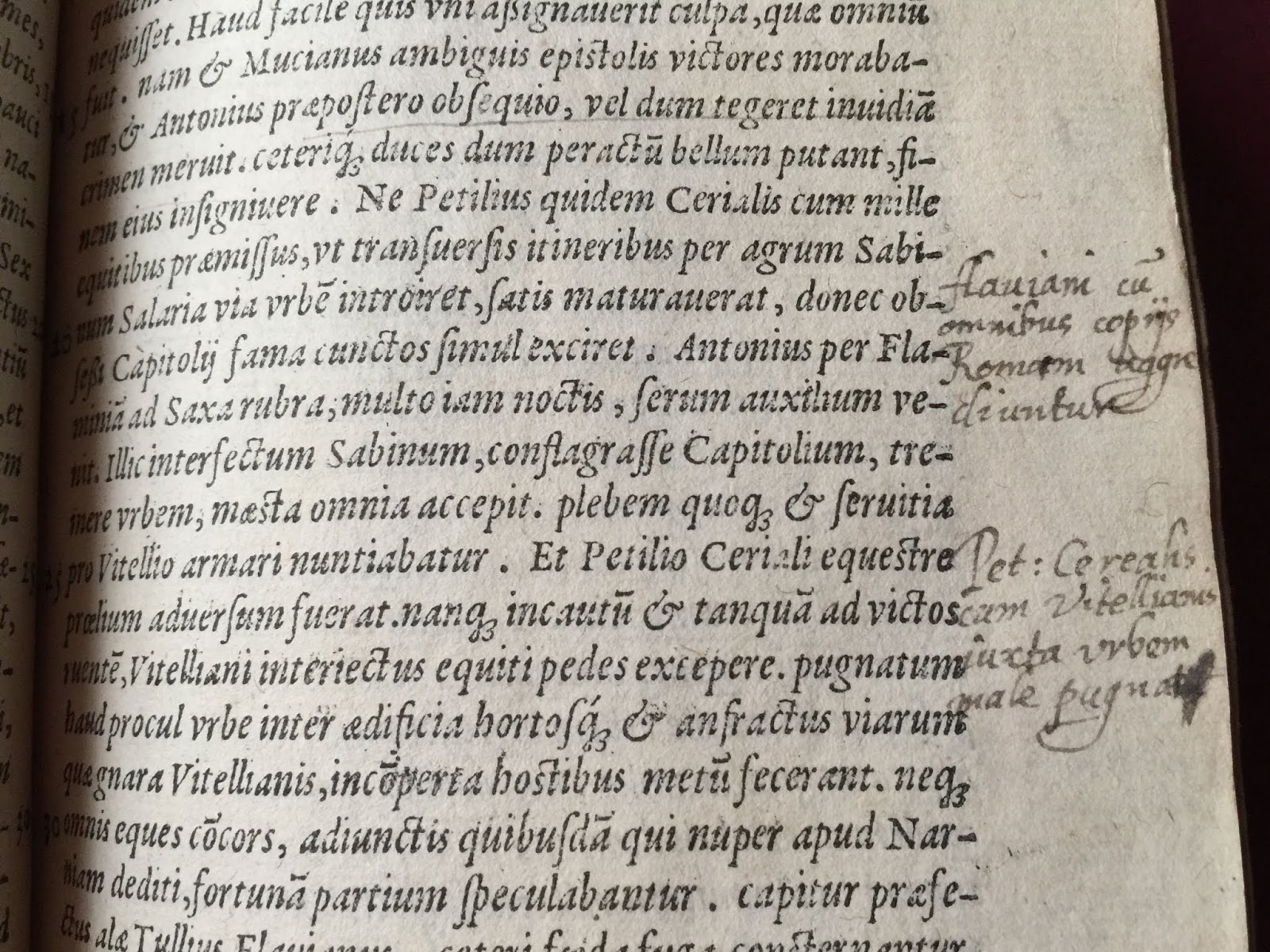

This relates to Petilius Cerialis

Tacitus History - Book 3 - Page 148


The above annotation relates to this:
Later the senate was convened and selected representatives to go to the armies and to persuade them in the interests of the state to agree on peace. The fortunes of these envoys varied. Those who met Petilius Cerialis ran the greatest dangers, for his soldiers scorned all terms of peace.
This is underlined one the page:
Miscuerat se legatis Musonius Rufus equestris ordinis, studium philosophiae [et placita Stoicorum aemulatus; coeptabatque permixtus manipulis]
Here is the Loeb translation:
Musonius Rufus had joined these delegates. He was a member of the equestrian order, a man devoted to the study of philosophy and in particular to the Stoic doctrine.
Below appears to be another mark, but I do not have a photo of the rest of the page.
This page has annotations both by Henry Neville and by Henry Savile.

The top of the page has this annotation which appears to be by Henry Neville:

Here is the bottom half of Page 149:

Then some text is underlined with a mark on the right:
iuxta scorta et scortis similes; quantum in luxurioso otio libidinum, quidquid in acerbissima captivitate scelerum, prorsus ut eandem civitatem et furere crederes et lascivire.
Here is the Loeb translation:
There were all the debauchery and passion that obtain in a dissolute peace, every crime that can be committed in the most savage conquest, so that men might well have believed that the city was at once mad with rage and drunk with pleasure.
Then at the bottom is Henry Savile's Annotation. It seems to relate to this text, with the first three words underlined:
Plurimum molis in obpugnatione castrorum fuit, quae acerrimus quisque ut novissimam spem retinebant. Eo intentius victores, praecipuo veterum cohortium studio, cuncta validissimarum urbium excidiis reperta simul admoventHere is the translation:
The greatest difficulty was met in taking the Praetorian Camp, which the bravest soldiers defended as their last hope. The resistance made the victors only the more eager, the old praetorian cohorts being especially determined.Here is a close-up of the annotation in Henry Savile's handwriting:
And the interlinear annotation:

I will leave it to experts in Latin/Greek paleography of the era to interpret these.
Tacitus History - Book 3 - Page 150

A large block of text is underlined:

Here is the text:
Contra Vitelliani, quamquam numero fatoque dispares, inquietare victoriam, morari pacem, domos arasque cruore foedare suprema victis solacia amplectebantur. Multi semianimes super turris et propugnacula moenium expiravere: convulsis portis reliquus globus obtulit se victoribus, et cecidere omnes contrariis vulneribus, versi in hostem: ea cura etiam morientibus decori exitus fuit.And the English translation from Loeb:
On their side the Vitellians, unequal though they were in numbers and in fortune, by striving to spoil the victory, to delay peace, and to defile the houses and altars of the city with blood, embraced the last solace left to the conquered. Many, mortally wounded, breathed their last on the towers and battlements; when the gates were broken down, the survivors in a solid mass opposed the victors and to a man fell giving blow for blow, dying with faces to the foe; so anxious were they, even at the moment of death, to secure a glorious end.
Here is the close-up of the annotation:


This annotation is at the beginning of Book 4:

The annotation relates to what the military did after their victory, here are the first lines of Book 4:
The death of Vitellius was rather the end of war than the beginning of peace. The victors ranged through the city in arms, pursuing their defeated foes with implacable hatred: the streets were full of carnage, the fora and temples reeked with blood; they slew right and left everyone whom chance put in their way.Tacitus Histories - Book 4 - Page 153


This section is underlined:
cum contra Tarracinenses nulla ope iuvarentur. Tanto proclivius est iniuriae quam beneficio vicem exolvere, quia gratia oneri, ultio in quaestu habetur. Solacio fuit servus VerginiiLoeb Classics has this translation:
while the people of Tarracina, on the other hand, received no assistance: so much easier is it to repay injury than to reward kindness, for gratitude is regarded as a burden, revenge as gain. The Tarracines, however, found comfort in the fact that the slave of Verginius [Capitonis]The annotation sends us to page 136, line 1:
Iuliano in partis Vespasiani transgresso, Ut conlata utrimque castra, haud magna cunctatione Iuliano in partis Vespasiani transgresso, Tarracinam occupavere, moenibus situque magis quam ipsorum ingenio tutam.Here is the Loeb translation:
Julianus did not long hesitate to join Vespasian’s party; then the combined forces occupied Tarracina, a town which was better defended by its walls and situation than by any ability on the part of the soldiers.And the annotation also sends us to Page 146, line 10:
Interim ad L. Vitellium servus Verginii Capitonis perfugit pollicitusque, si praesidium acciperet, vacuam arcem traditurum, multa nocte cohortis expeditas summis montium iugis super caput hostium sistit: inde miles ad caedem magis quam ad pugnam decurrit.And the Loeb translation:
In the meantime a slave of Verginius Capito escaped to Lucius Vitellius and promised that if he could have a force, he would hand over the citadel, which was empty.This is also underlined:
At Romae senatus cuncta principibus [solita Vespasiano decernit]
But at Rome the senators voted to Vespasian all the honours and privileges usually given the emperors.Tacitus - Histories Book 4 - Page 161

This text is underlined:
Libertatem natura etiam mutis animalibus datam, virtutem proprium hominum bonum; deos fortioribus adesse: proinde arriperent vacui occupatos, integri fessos. Dum alii Vespasianum, alii Vitellium foveant, patere locum adversus utrumque.And here is the translation:
Liberty is a gift which nature has granted even to dumb animals, but courage is the peculiar blessing of man. The gods favour the braver: on, therefore, carefree against the distressed, fresh against the weary. While some favour Vespasian and others Vitellius, the field is open against both.Here is Savile's annotation, which seems to reference Page 160 and I believe is a reference to the Revolt of Batavi.

And there is an interlinear annotation, it is not clear who made these. They are references to page 159 line 28 and 163 line 27. These also related to the Revolt of Batavi; the name Munius Lupercus is underlined. To quote Wikipedia: "At Castra Vetera the situation was desperate. Food supplies had run out and the besieged legions were eating horses and mules to survive. With no prospect of a relief, the commander of the troops, Munius Lupercus, decided to surrender."

Here is the translation of this section:
When, however, terrified messengers brought word of the capture of camps, the destruction of cohorts, and the expulsion of the Roman name from the island of the Batavians, he ordered Munius Lupercus, who commanded the two legions in winter quarters, to take the field against the foe.Tacitus - Annals Book 1 - Page 253
This annotation is from Casson and Rubinstein's Sir Henry Neville Was Shakespeare: The Evidence

Here is Grenewey's translation of this section:
Drusus being made overseer of a play of fencers, set forth in his own and his brother Germanicus name; because he seemed to take ouer great pleasure in shedding of blood; stroke a fear into the peoples minds, and as it is reported, was disliked of his father. Why Tiberius forbear to see this spectacle, it was diversely construed: some thought be∣cause he loathed to be in great assemblies: some because he was of a melancholy sad disposition: and also misdoubting least some should fall into comparison, betwixt him and Augustus, who was wont to be present at such plays with courteous and mild carriage.Tacitus - Annals Book 3 - Page 304

These annotations are written in a slightly different style, but Henry Neville varied his handwriting quite a bit, and this is consistent with other samples of his handwriting. My guess is that these are later annotations:


There is some underlining, here is the broad context:
dum alii quoquo modo audita pro compertis habent, alii vera in contrarium vertunt et gliscit utrumque posteritate. At Drusus urbe egressus repetendis auspiciis mox ovans introiit. Paucosque post dies Vipsania mater eius excessit, una omnium Agrippae liberorum miti obitu: nam ceteros manifestum ferro vel creditum est veneno aut fame extinctos.And the English from Loeb:
one school admits all hearsay evidence, whatever its character, as indisputable; another perverts the truth into its contrary; and, in each case, posterity magnifies the error. Drusus, who had left the capital, in order to regularize his command, entered it shortly afterwards with an ovation. A few days later, his mother Vipsania died—the only one of all Agrippa’s children whose end was peace. The rest perished, part, it is known, by the sword; part, it was believed, by poison or starvation.Here is Grenewey:
So doubtful are all weighty matters; whilst some take all as certain, howsoever they hear it: others report a truth otherwise then it is: posterity adding to both.
IIII. Wars renewed in Africa under Tacfarinas: who is defeated by Apronius: Lepida condemned for changing a child.
But Drusus being gone out of the city, once more to learn future things by the flying of birds; entereth in again, with a small triumph. And a few days after, Vipsania his mother died, only of all Agrippas children, of a natural death: because it was certainly believed, that some died by the sword; others by poison or famine.
Please note, this annotation:

Appears to match this heading in Grenewey: "IIII. Wars renewed in Africa under Tacfarinas: who is defeated by Apronius: Lepida condemned for changing a child."
Tacitus Annals - Book 4 - Page 361
This annotation is from Casson and Rubinstein's Sir Henry Neville Was Shakespeare: The Evidence

Here is Grenewey's translation of the passage that relates to a theater:
For an Amphitheater begun at Fidena, one Atilius a freed man, to set forth a play offencers; as one having neither abundance of wealth, nor ambitious in winning favour of the people; but by niggardly sparing to make a base gain in the workmens hire; did neither lay a sound foundation, nor fasten the timber frame erected upon the same. Thither flocked many, very desirous of such shows, both men and women of all ages; partly by reason it was so near vunto them; and partly because that, during Tiberius empire, they were barred from such pastimes; whereby the mischief was the greater.Tacitus Annals - Book 4 - Page 387
This annotation is from Casson and Rubinstein's Sir Henry Neville Was Shakespeare: The Evidence

It relates to the Phoenix. Here is Grenewey's translation:
WHen Paullus Fabius and L. Vitellius were Consuls, after manie ages were past, the bird Phoenix came into AEgypt, and ministered matter to the most learned of the country, and also Greeks, of disputing many things concerning that miracle. Of which it seemeth good unto me to lay down such things as they agree of, and many which rest doubtful; yet notwithstanding worthy the knowledge.Tacitus Annals - Book 4 - Page 493

Here is the translation from page 210 of Grenewey's Tacitus:
But Suetonius with wonderful constancy passing even among the enemies, went on to London, not greatly famous by the name of a colony, but for concourse of Merchants, and provision of all things necessary, of great fame and renown.Tacitus Annals - Book 14 - Page 501

This line is underlined in Latin:
prospera populi et militum fama Rufus, quod apud Neronem adversum experiebatur.
Here is the translation from Page 216 of Grenewey:
Rufus was of good reputation and fame with the people, and accepted of the soldiers, which he found by experience to breed Nero's mislike.Here is the annotation relating to Nero accusing Seneca:


The word "Post" is underlined. To the left is an annotation "Mors Popaeae" This is a reference to the death of Poppaea Sabina. Here is the Grenewey's translation, note how the two annotations relate directly to the heading in Grenewey:
The death of Poppaea. Banishment and death of others.
AFter the pastime was ended, Poppaea died by a sudden anger of her husbands, striking her with his foot being with child. Neither do I believe that she was poisoned, although some writers do so report, of hatred rather than truth: for he was desirous of children and blinded with the love of his wife.Further down on the page is a reference to the banishment of Cassius and Silanus:

The page also has a correction in the same handwriting on line 30, "vt" is crossed out and replaced with "ne":

This correction shows a very detailed engagement with the text. Modern editions of the Annals also have "ne" here, instead of "vt".
Tacitus Annals - Book 16 - Page 552

At the top a long passage about Petronius is underlined:
nec tulit ultra timoris aut spei moras. Neque tamen praeceps vitam expulit, sed incisas venas, ut libitum, obligatas aperire rursum et adloqui amicos, non per seria aut quibus gloriam constantiae peteret. Audiebatque referentes, nihil de inmortalitate animae et sapientium placitis, sed levia carmina et facilis versus. Servorum alios largitione, quosdam verberibus adfecit. Iniit epulas,1 somno indulsit, ut quamquam coacta mors fortuitae similis esset.
Here is the Loeb translation:
He declined to tolerate further the delays of fear or hope; yet still did not hurry to take his life, but caused his already severed arteries to be bound up to meet his whim, then opened them once more, and began to converse with his friends, in no grave strain and with no view to the fame of a stout-hearted ending. He listened to them as they rehearsed, not discourses upon the immortality of the soul or the doctrines of philosophy, but light songs and frivolous verses. Some of his slaves tasted of his bounty, a few of the lash. He took his place at dinner, and drowsed a little, so that death, if compulsory, should at least resemble nature.
Here is Grenewey:
Not able any longer to endure the lingering between hope, or fear, yet did not rashly kill himself, but cutting his veins, and binding them up as pleased him, opened them again, and talked with his friends, though not of any serious matter, or worthy to purchase the glory of constancy: but gave ear to those which discoursed with him, yet nothing of the immortality of the soul, or opinions of wise men, but of light verses, and easy songs. On some of his slaves he bestowed gifts, and on some stripes. He went sometimes abroad, and gave himself to sleep that although his death was constrained, yet it should be like a casual death.This phrase is also underlined:
[Fregitque anulum,] ne mox usui esset ad facienda pericula.Here is Loeb:
[His signet-ring he broke,] lest it should render dangerous service later.And Grenewey:
And break his seal, lest afterward it might serve to breed danger to others.This annotation is very interesting:

Because it seems to match this heading in Grenewey quite closely:
Here are two more annotations:V. Neroes hatred against Thraseas Paetus, and Bareas Soranus.

Tacitus Annals - Book 16 - Page 553

The Latin “Ut quondam C. Caesarem” inquit “et M. Catonem" is underlined. Grenewey translates this as:
the city desirous of garboile, spake of C. Caesar, and M. CatoLoeb Classics has:
this discord-loving state prated of Caesar and Cato

Once again, the text is carefully corrected, with the addition of the word "cura". The asterisk was printed as part of the book and points the reader to the notes in the back which suggest this change.
Tacitus Agricola - Page 585

This is underlined:
cessit, artem et usum et stimulos addidere iuveni, intravitque animum militaris gloriae cupido, ingrata temporibus quibus sinistra erga eminentes interpretatio nec minus periculum ex magna fama quam ex mala.
Here is the Loeb translation:
yet furnished science, experience, and incentives to the subaltern. There entered his heart a desire for that military distinction which was unwelcome to an age which regarded eminence of every kind unfavourably and in which good report was as perilous as bad.Next to this underlining is this annotation:

Which seems to refer to this marriage:
he married Domitia Decidiana, a woman of high lineage. The marriage proved at once a distinction and a strength to him in his upward path; their life was singularly harmonious,This text is also underlined:
in vicem se anteponendo, nisi quod in bona uxore tanto maior laus, quanto in mala plus culpae est.Here is the Loeb translation:
thanks to mutual affection and putting each other first; though, indeed, a good wife has the greater glory in proportion as a bad wife is the more to blame.And here is the annotation to the right of that:

Tacitus Agricola - Page 601

These words are underlined:
adprobate rei publicae numquam exercitui imputari potuisse aut moras belli aut causas rebellandi.Here is the Loeb translation:
prove to the state that the army has never been to blame if the war has dragged on or if rebels have had their opportunity.
This missing word is added:

And there is this annotation is a reference to the Grampian Mountains. You can read about it here:

The Annotations on the End Page
On a blank page of the book is a list of Roman emperors. The handwriting seems a bit messy but it matches in general the rest of the annotations in the book:

Look at this detail:

It appears to be Henry Savile's handwriting correcting the writing of the first person.
I believe this is evidence that this book was used as a sort of textbook by Henry Neville and his tutor Henry Savile. Some of the later annotations though seem more sophisticated, so it could be that the annotations were added over time.
Conclusion
The annotations in this book deserve much thorough study. This is just a quick overview to make the information available to scholars. The importance cannot be overstated for understanding the works of Shakespeare, especially Titus Andronicus.


Subscribe to:
Posts (Atom)